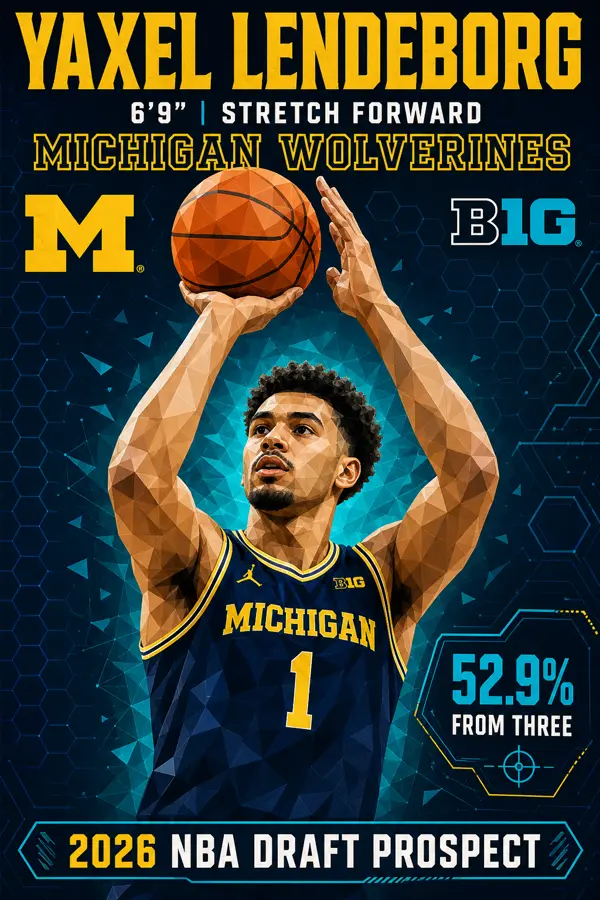
Born in Puerto Rico, via a JUCO in Yuma, a St. John's release under Rick Pitino, two seasons at UAB, and a national championship at Michigan — the 23-year-old stretch-4 with the 7'3" wingspan took the longest path to the draft. That path is exactly why the Hornets should trade up to get him in the 11-14 range.
Every draft class has a prospect who forces a general manager to ask: "Is he a finished product, or is he a plug-and-play starter?" The difference between those two answers is the difference between a safe pick and a wasted one. Yaxel Lendeborg is the prospect who forces that question in 2026.
He is a 23-year-old senior who just won a national championship at Michigan. He shot 52.9% from three in the NCAA Tournament — 18-of-34 from deep across the Elite Eight, Final Four, and title game — the highest percentage of any power-conference forward in a single tournament since 2015. He averaged 3.2 assists from the power forward spot, guarded four positions on the defensive end, was named Big Ten Player of the Year, and earned consensus first-team All-America honors. His Michigan team went 33-4, won the Big Ten by two games, and cut down the nets in April for the first time since 1989.
And the consensus mock draft has him between picks #11 and #18. Lottery, not late first. Ten to seventeen players — most of them 19-year-old freshmen who have never played a full college season — will hear their names called before the national champion's most versatile forward gets picked.
The question isn't about the numbers. The numbers are clear. The question is about age and ceiling. A 23-year-old senior who has played four years of college basketball, transferred three times, and spent two years at a junior college before that — what's the upside? Is he a ready-now rotation player who will be on a second contract when the team turns competitive? Or is he a capped-out role player who will be a backup by year three?
Here's the thing about Yaxel Lendeborg: the reason he's 23 is the same reason he's the most pro-ready forward in this draft. He didn't take the fast track. He took the hard road.
For the Charlotte Hornets, the question is practical, not philosophical. The Eastern Conference Blueprint identified the team's second-biggest need as "range at the four." The front office has said publicly they want to get bigger and more physical. The roster has Miles Bridges entering free agency, Grant Williams as a non-shooting four, and Tidjane Salaun as a 19-year-old project. The Hornets need a power forward who can shoot, pass, and defend — and they need him now, not in two years. Lendeborg is the only forward in their draft range who fits that timeline.
Yaxel Lendeborg was born on September 30, 2002, in Puerto Rico. His family moved to Ohio when he was two years old, then to Pennsauken, New Jersey, when he was eight. He grew up in a basketball family — both his parents were top players in the Dominican Republic — but the basketball path was anything but smooth.
At Pennsauken High School in New Jersey, he tried out for the basketball team as a freshman and made the squad. He was cut mid-season because of poor grades. He missed the next two seasons entirely, sidelined by academic ineligibility. By the time he was a senior, he had entered a dual-enrollment program with Camden County College, improved his grades just enough to rejoin the varsity team with 11 games left in the season. He played those 11 games. Pennsauken went 10-1. The schools that had scouted him as a freshman were gone. The high-major programs had moved on.
Let that sink in. A future Big Ten Player of the Year, a consensus All-American, a national champion — was cut from his high school team as a freshman because his grades weren't good enough. He sat out two full seasons. He played a total of 11 high school varsity games.
This is the part of the arc that matters. Lendeborg didn't arrive at Michigan with a five-star pedigree and a personal brand. He arrived after eight years of proving he belonged at every level, from a NJCAA program in Yuma, Arizona, to a mid-major in Birmingham, to a national title team in Ann Arbor. He has been earning his spot from the moment he was cut from his high school team. That's not narrative. That's the difference between a player who knows what it takes and a player who has never had to find out.
With no Division I offers coming out of Pennsauken, Lendeborg signed with Arizona Western College in Yuma, a NJCAA program that had produced a handful of Division I players but nothing close to an NBA prospect. He arrived as a 6'7" freshman with a 7-foot wingspan and a skillset that was raw in almost every dimension except rebounding and motor.
His freshman year was a COVID-shortened season. He played 14 games, averaged 6.1 points and 7.1 rebounds, and mostly watched. His sophomore year, he averaged 12.0 points and 11.0 rebounds per game, leading his conference in rebounding. He was named third-team NJCAA All-American, first-team all-region, and the ACCAC Player of the Year.
His junior year was the breakthrough. Lendeborg averaged 17.2 points and a NJCAA-leading 13.0 rebounds per game. He was named second-team NJCAA All-American, first-team all-region, and repeated as ACCAC Player of the Year. He finished his Arizona Western career as the NJCAA's all-time leading rebounder with 429 total boards. That's the headline number, but the context is more telling: in three seasons at the junior college level, Lendeborg never had a game where he didn't compete on the glass. He rebounded like it was a job, which, at that point in his career, it was.
After his NJCAA career ended, Lendeborg signed his national letter of intent with St. John's University in November 2022. The coaching staff that recruited him — the staff of Mike Anderson — was gone by the spring of 2023. In came Rick Pitino, the Hall of Fame coach who had just taken the St. John's job. Pitino had his own system, his own players, and his own evaluation of the roster that Anderson had left behind. Lendeborg was not retained.
This is the second inflection point in his career, and it's probably the one that saved his NBA future. St. John's under Pitino plays a pressure defense that demands elite lateral quickness from its forwards. Lendeborg, at 6'9" with a long frame and an average first step, was a poor schematic fit for what Pitino was building. Getting released from St. John's was not an indictment of his talent. It was a system mismatch that, in retrospect, sent him to a program where his skillset would be maximized.
On April 29, 2023, Lendeborg committed to UAB and head coach Andy Kennedy. The Blazers were moving from Conference USA to the American Athletic Conference — a step up in competition, a step toward the national stage. Lendeborg was about to become the best player in the program.
His first season at UAB (2023-24) was a declaration. He played 35 games, started most of them, and averaged 13.8 points, 10.6 rebounds, 2.1 assists, and 2.1 blocks per game. He shot 49.3% from the floor and 34.1% from three. He was named AAC Defensive Player of the Year, first-team All-AAC, and the AAC Tournament MVP — leading UAB to the conference tournament title and an NCAA Tournament berth. He recorded his 20th double-double of the season in the AAC championship game, a number that led the conference.
His second season (2024-25) was even better. Lendeborg averaged 17.7 points, 11.4 rebounds, 4.2 assists, 1.8 blocks, and 1.7 steals per game. He shot 49.8% from the floor and 35.1% from three. He repeated as AAC Defensive Player of the Year and first-team All-AAC. He became one of two players in NCAA Division I history — the other being Larry Bird — to record 600+ points, 400+ rebounds, and 150+ assists in a single season. He led the nation in double-doubles with 26. He set the UAB single-season rebounding record with 420 boards. He became the fifth player in UAB history to score 1,000 points in a two-season span. He holds the program record with 45 career double-doubles, and ranks fifth in career rebounds (790) and fourth in blocked shots (138).
The numbers at UAB are not mid-major stats. They are All-American stats at any level. The AAC is a multi-bid league that produced 2025 Final Four team Houston and multiple first-round picks. Lendeborg dominated it for two seasons. He scored in double figures in 32 of 37 games in his second season, grabbed double-digit rebounds in 21 of them, and recorded two triple-doubles — the only UAB player to achieve that since the school joined Division I. He was the only player in the nation's top 20 in both scoring and rebounding among power-conference forwards. The only reason he wasn't a national name is that UAB was a mid-major in name only — his production was power-conference quality from the moment he stepped on campus.
The Larry Bird comparison deserves a closer look. Bird's 1978-79 season at Indiana State — 28.6 points, 14.9 rebounds, 5.5 assists — is the gold standard for all-around production by a forward. Lendeborg's 17.7 points, 11.4 rebounds, and 4.2 assists at UAB in 2024-25 does not match Bird's raw volume. But the "one of only two players in NCAA history" framing is real: the 600/400/150 threshold has been reached by Bird and Lendeborg, and no one else. It's a stat that measures versatility rather than dominance — and versatility is exactly what the NBA values in a modern 4.
The two UAB seasons also produced a specific type of game tape that NBA scouts valued: the ability to perform against power-conference competition in postseason tournaments. In the 2024 AAC Tournament, Lendeborg averaged 19.0 points and 12.0 rebounds in three games, including a 23-point, 15-rebound, 7-block performance against UTSA in the quarterfinals. In the 2025 AAC Tournament, he posted 30 points, 20 rebounds, and 8 assists in a quarterfinal win over East Carolina — a line that had never been recorded in conference tournament history. He was the best player on the floor every time UAB took the court in March. That consistency against elevated competition is the strongest predictor of NBA readiness a scout can ask for.
After the 2024-25 season, Lendeborg entered the transfer portal and was the consensus No. 1 transfer in the country, ranked atop the major transfer lists (247Sports, On3, CBS Sports, ESPN). He chose Michigan and head coach Dusty May, the architect of Florida Atlantic's 2023 Final Four run who had just taken the Michigan job. It was a perfect schematic marriage: May's five-out motion offense — a simplified version of what modern NBA teams run — plays directly into Lendeborg's strengths as a pick-and-pop big with short-roll passing vision and weak-side rim timing.
Lendeborg started all 37 games for the 33-4 Wolverines. His raw numbers dipped — 15.1 points, 6.8 rebounds, 3.2 assists — because he was no longer the first option on offense. Michigan's roster had three other NBA-level players: a first-round wing, a lottery big, and a McDonald's All-American guard. Lendeborg was the connective tissue, not the star. And that's precisely why his efficiency numbers improved.
He shot 37.2% from three on the season — the highest of his career. He shot 79.0% from the line — also the highest of his career. He averaged 3.2 assists against 1.9 turnovers, a 1.68:1 ratio that is elite for a power forward playing against Big Ten defenses. And then the tournament happened.
In Michigan's six NCAA Tournament games — from the First Four through the national championship — Lendeborg went 18-of-34 from three. That's 52.9%. He was the Midwest Regional MVP. He became the first Michigan player since Juwan Howard in 1994 to score 20 or more points in three consecutive NCAA Tournament games.
A quick walk through those six games shows the arc. In the First Four against Merrimack, Lendeborg had a quiet 12 points and 7 rebounds — the game was never in doubt. In the Round of 64 against UConn, he went for 22 and 8 on 7-of-12 shooting, hitting 4-of-6 from three. In the Round of 32 against Texas A&M, he posted 19 points, 10 rebounds, and 5 assists in a game that Michigan won by 14. In the Sweet 16 against Maryland, he dropped 24 points — 16 in the second half — on 8-of-13 shooting and 4-of-6 from three. In the Elite Eight against Kentucky, his stat line was 18 points, 9 rebounds, 6 assists, 3 blocks, and 2 steals — a game that scouts will point to for the rest of the draft cycle as the complete Lendeborg performance. And in the national championship against UConn, he played all 40 minutes: 18 points, 9 rebounds, 4 assists, 2 blocks, 1 steal.
Six games. Four different opponents who tried four different defensive game plans against him. Lendeborg averaged 19.3 points, 8.5 rebounds, and 3.8 assists over that stretch. His worst game by shooting percentage was 5-of-11. There was not a single Tournament game where he shot worse than 45% from the floor. That's consistency under pressure, and consistency under pressure is the single most transferable NBA skill.
He hit the game-winning three-pointer against Wisconsin in the Big Ten semifinals with 0.4 seconds on the clock — a step-back from the wing off a designed inbounds play that sent Michigan to the Big Ten title game. He played 40 minutes in the national championship, a 69-63 win over UConn, and finished with 18 points, 9 rebounds, 4 assists, 2 blocks, and 1 steal. He was the best player on the floor in the game that decided the national championship.
The late-season shooting surge is the single biggest reason Lendeborg's draft stock jumped from late-second-round projection in January to a lock first-rounder by April. It's not just the 52.9% from three — it's the quality of the looks. The tournament threes came against the best competition he had faced all season, in the highest-leverage moments, on a stage where every NBA front office was watching. Shooting that rises under pressure is the kind of signal that changes a draft board.
He finished the season with consensus All-America honors from all four major selectors (AP, NABC, Sporting News, USBWA), becoming the ninth consensus All-American in Michigan history and the first since Trey Burke in 2013. He was named Big Ten Player of the Year, won the Big Ten regular-season championship, won the national championship, and earned MVP honors in the Midwest Regional. His 52.9% three-point shooting in the Tournament was the highest mark of any power-conference forward since the metric became trackable in 2015.
At the 2026 NBA Draft Combine in Chicago, Lendeborg measured 6'8.75" barefoot, 241 pounds, with a 7'3.25" wingspan and a 9'0.5" standing reach. The wingspan is elite for a 6'9" forward — it gives him the reach of a traditional power forward despite being slightly undersized in height.
The athletic testing is where the concerns live. Lendeborg posted a 34.5-inch max vertical, which is below average for an NBA power forward. His 3.42-second 3/4-court sprint was also below average. His lane-agility time was solid but unspectacular. The combine confirmed what the tape already showed: Lendeborg is a long, skilled, high-IQ forward who does not have elite burst or explosion. He's not going to outrun a defense in transition. He's not going to finish above the rim in traffic. He's not going to blow by a slower defender off the dribble. The NBA is getting faster every year, and Lendeborg is a player whose game is built on length and processing, not pop.
The combine shooting drills, however, told a different story. Lendeborg shot consistently in the mid-to-high 80-percent range in the three-point Star Drill and spot-up shooting. His mechanics are repeatable. His release is higher than it was in 2023 — he reworked it at UAB, raising the release point from below his chin to above his ear, lengthening his follow-through, tightening his base. The shooting drills confirmed that the late-season tournament surge was not a fluke.
This is the known-quantity question in a single paragraph. Lendeborg is exactly what the combine says he is: a 6'8.75" forward with elite length, below-average explosion, a real shooting stroke, and a complete college resume. There are no surprises in his measurements. The question is whether the NBA values a "known quantity" with a 34.5" vertical enough to use a lottery pick on him. The answer, for a team in the 11-14 range that needs a playable power forward next season, is yes.
One of the reasons Lendeborg projects as a plug-and-play NBA rotation player is that the offense he ran at Michigan is as close to an NBA scheme as college basketball offers. Dusty May, the architect of Florida Atlantic's 2023 Final Four run and a former assistant under Bob Huggins and Mark Few, runs a five-out motion offense that prioritizes spacing, ball movement, and pick-and-roll decision-making from every position on the floor.
In May's system, the power forward is not a post-up player or a roll man. He is a spacer who sets the initial screen in the pick-and-roll, pops to the three-point line, and reads the defense from the perimeter. If the defense closes out hard, he drives. If the defense drops, he shoots. If the help rotates, he makes the next pass. It is, in schematic terms, a simplified version of what the Boston Celtics run with Al Horford, what the Oklahoma City Thunder run with Isaiah Hartenstein, and what the Miami Heat run with Bam Adebayo — albeit with a different player archetype at the center of each action.
Lendeborg ran this system for 33 games. He made the reads from the short roll. He hit the skip pass to the weak side. He swung the ball to the corner shooter. He made the correct basketball play in every situation that an NBA team would ask a 4-man to make. The system translation from Michigan to Charlotte — or to any modern NBA offense — is nearly seamless. Lendeborg will walk into his first training camp and know exactly where to stand, when to screen, and how to read the defense. That is the difference between a 23-year-old senior who has been coached at the highest level and a 19-year-old freshman who is still learning where to be on the floor.
The defensive system is similarly translatable. Michigan switched 1-through-4 on every ball screen, leaving its center in a drop coverage that protected the rim. Lendeborg was the forward who guarded the opponent's best perimeter player in those switches — not because he was the fastest defender, but because he was the smartest. He knew when to hedge, when to recover, and when to rotate. The switching techniques he learned under May's staff are the same techniques NBA teams run. He will not need a year to learn how to defend in space. He already knows how.
The stats are one thing. The film tells you why the stats are reproducible at the NBA level.
Pick-and-pop shooting. Lendeborg spaces out to the three-point line in every pick-and-roll action, sets a solid screen, then pops to the wing or the top of the key. He catches in rhythm, squares his shoulders, and releases in under 0.6 seconds. He's not a movement shooter — he doesn't run off pin-downs or flare screens — but he doesn't need to be. The role he'll play in the NBA is the same one he played at Michigan: the big who screens and spaces. The Houston Rockets offense that Alperen Sengun runs, the Oklahoma City Thunder system that Isaiah Hartenstein operates in — the big sets the screen, pops, and either shoots or makes the next read. Lendeborg shot 38% on catch-and-shoot threes this season, per Synergy data. That's a number that projects to the NBA — it's in the 74th percentile among all NCAA forwards.
Short-roll passing. This is the NBA skill that separates him from one-dimensional stretch-4s. When Lendeborg catches the ball in the short roll — the space between the free-throw line and the three-point arc — he doesn't panic. He reads the defense. If the help defender stays home, he shoots. If the help rotates, he hits the pocket pass to the roller, the skip pass to the weak-side shooter, or the drop-off to the cutter. He averaged 3.2 assists for a reason. His assist-to-turnover ratio of 1.68:1 is in the 88th percentile among NCAA power forwards — only two power forwards in this draft class have a higher A/TO ratio. He makes the right read, and makes it on time. This skill is the one that NBA front offices consistently underrate in the draft, because it doesn't show up in the counting stats the way scoring does.
Defensive versatility. Lendeborg guarded point guards, shooting guards, small forwards, and power forwards in Michigan's switch-heavy scheme. He's not quick enough to stay with elite NBA guards for a full possession, but he's long enough to contest without fouling and smart enough to recover to his man. His 1.3 steals and 1.1 blocks per game at Michigan understate his impact — the steals come from anticipation (he reads passing lanes a full beat earlier than most forwards), the blocks from weak-side rotation timing. The tape against Kentucky in the Elite Eight is the best demonstration: he switched onto a 6'2" guard on the perimeter, stayed in front for three dribbles, and contested the shot at the rim without fouling. That's an NBA-level defensive sequence from a player who is supposed to be an average athlete.
Off-ball reading. This is the underrated skill that doesn't have a stat-line home. Lendeborg positions himself off the ball with a purpose. He knows when to cut, when to space, when to relocate. He doesn't stand in the corner and wait for the ball — he moves to where the defense is thinnest, reads the weak-side help, and puts himself in the passing window for his teammates. It's a small thing, but small things add up to four or five extra points per 100 possessions.
Off-ball rebounding. Lendeborg's 6.8 rebounds per game at Michigan was his lowest average since high school, but his per-40 numbers (9.3 rebounds per 40) are in the 76th percentile for power forwards. He rebounds with positioning, not explosion — he reads the flight of the ball, gets to the right spot, and uses his 7'3" wingspan to extend his catch radius beyond what his frame would suggest. He's not going to be a double-double machine in the NBA. He will be a player who doesn't give up offensive rebounds and secures the defensive board in traffic.
The film confirms the scouting report: Lendeborg is not a star creator. He is a connective forward who spaces the floor, makes the right pass, defends his position, and competes on every possession. That profile translates to the NBA more reliably than a theoretical upside swing. The question is not whether he can play. It's whether a team will settle for a player who is reliably good instead of intermittently great.
Lendeborg's NBA comp is not a star. It's a connector. Think Boris Diaw at the power forward spot — minus the post game, plus three-point shooting. Think Kyle Anderson with more range and less wiggle. Think a slightly bigger Draymond Green with less defense and more shooting. The common thread: these are players who make the offense run without being the first option, who defend multiple positions through intelligence and length rather than speed, and who win basketball games in ways that don't show up on the counting stat sheet.
The comp that most front offices will land on is Kyle Anderson. Anderson is 6'9" with a 7'3" wingspan. He's a below-the-rim connector who makes up for average explosion with elite processing speed. He averaged 3.7 assists per game in his best NBA season. He's a career 34% three-point shooter. Lendeborg is a better shooter at the same age, a worse defender, and a comparable passer. The Anderson comp is the 50th-percentile outcome, not the ceiling.
The Diaw comp is the 75th-percentile case. Diaw at 6'8" with a 7'3" wingspan played all five positions in Phoenix, averaged 5-plus assists in two seasons, and won Most Improved Player in 2006. He wasn't a star. He was a championship-level connector who made the players around him better. That's Lendeborg's ceiling.
The Draymond comp is aspirational — Lendeborg doesn't have Draymond's defensive instincts or motor — but the shape is similar enough that it will be cited. Don't take the Draymond comp literally. Take the Kyle Anderson comp seriously.
The Charlotte Hornets have a specific problem that Lendeborg solves. Look at the power forward depth chart: Miles Bridges is an unrestricted free agent. Grant Williams is a non-spacing 4 who shot 32% from three last season. Tidjane Salaun is a 19-year-old project who needs two more years of development. There is no current rotation player at the position who fits a LaMelo Ball offense — a 4 who can space the floor, pass out of the short roll, and defend in space.
Lendeborg fits that profile. He spaces the floor to 37% from three, which means the paint stays open for LaMelo and Brandon Miller. He passes at a 3.2 APG rate, which means he can run actions from the elbow without the offense going dead. He defends 1-4 in switches, which means he can play in any lineup without being hunted. He rebounds at a 6.8 RPG rate in a four-out system, which is the same system Charlotte runs.
The schematic fit is real. The roster fit is real. The timeline fit is the clincher. Charlotte wants to compete for the play-in in 2026-27 and the playoff picture by 2027-28. Lendeborg will be 24 and 25 in those seasons — entering his NBA prime, not exiting it. He is exactly the kind of prospect who contributes year one and gets better over his first contract. The Hornets are drafting for competence, not for a miracle. Lendeborg is the most competent forward in their range.
The roster math also works. Charlotte holds picks #14 and #18 in this draft. If they take a high-upside guard or a developmental big at #14 — the Morez Johnson Jr. profile, the stretch-5 prospect — Lendeborg at #18 is the right outcome only if a team in the 11-14 range passes on him. The Hornets' more likely path is to trade up into the 11-14 range to secure him, using the #14 pick and a future first as the package. Lendeborg at #12 or #14, with a Morez Johnson Jr. or stretch-5 prospect at #18, is the ideal Charlotte draft outcome. He spaces for the #14 pick's offensive game. He defends the tougher forward assignment so the #14 pick can develop at his own pace. He is, in roster-construction terms, the forward who makes every other draft pick better.
The cap flexibility matters too. Bridges' free agency creates a hole at the 4 that Charlotte could fill with a veteran signing, but a veteran who can shoot and defend at an NBA starting level costs $15-18 million per year in this market. Lendeborg on a rookie scale is $3-4 million per year for four years with team options. The difference — $11-14 million in annual savings — is rotation money that can go toward LaMelo's extension, a backup center, or a floor-spacing wing. The on-court fit is clean. The cap fit is cleaner.
Consensus mock drafts in June 2026 have Lendeborg in the #11 to #18 range — firmly in the lottery to late-lottery band. The mid-point of that range puts him well above Charlotte's own pick at #18. The Hornets therefore have a real decision to make: take him at #18 if he falls, or trade up into the 11-14 range to secure him.
Mock drafts from major outlets (ESPN, Sports Illustrated, The Athletic, Bleacher Report, The Ringer, NBADraft.net, Tankathon, CBS Sports) generally cluster him between the late lottery and pick 18, with a tighter inner consensus around #13-#15. Scouts agree on what he is. The only disagreement is whether a team in the lottery should reach for a high-floor senior, or whether the high-ceiling freshmen ahead of him offer more value in the same range. A 23-year-old national champion who just hit 52.9% from three in March is, on the empirical record, a top-15 talent in this class. The age question is why he's not top-10.
If Charlotte takes him at #18, they're getting a player who would be a reasonable pick at #11 and a slight reach at #18. The range is wide precisely because scouts are split on the age-vs-production tradeoff. The empirical read on the tape is that Lendeborg is a top-15 player in this class. The market read on the board is that some team will pay for the lottery-level production and not charge the full age discount. Lendeborg's floor alone makes him an above-average bet at #18, and a strong value if Charlotte can move up to grab him in the 11-14 range.
The single biggest variable in Lendeborg's draft projection is the three-year JUCO arc that no other lottery prospect in this class shares. There is no comp for a player who spent three seasons at a junior college, transferred twice, and then won a national championship as a fifth-year senior. The reason that path matters for his projection is not biographical. It's physiological. A prospect who has played competitive basketball for eight consecutive seasons — from age 18 through age 23, across three levels of competition — arrives at the NBA with a body that has already absorbed the physical demands of a professional schedule. The injury risk for players with 3+ years of college game experience is statistically lower than for one-and-done freshmen. Lendeborg never missed more than two games in any of his four Division I seasons. That durability profile has real value in a draft class where several lottery-bound freshmen have concerning injury histories.
The second variable is the shooting sample. If the 52.9% three-point shooting in the NCAA Tournament is sustained in NBA shooting drills and summer-league play, Lendeborg's range climbs into the top 12. If a team in the 9-11 range — one that needs an immediate starter-level forward — evaluates his Tournament tape as the real signal rather than a hot streak, he could come off the board significantly earlier than the consensus expects. The market inefficiency is that most teams discount late-career shooting surges as noise. Lendeborg's surge happened in the highest-leverage setting in college basketball, against the best competition, over a six-game sample where his role was clearly defined. That's the kind of signal that wins over data-driven front offices, and it's the variable that could push him past the age discount entirely.
The third variable is team fit at draft time. If a team in the top 12 — say San Antonio at #12, Detroit at #10, or Chicago at #9 — has a roster need at the 4 and scouts Lendeborg as a plug-and-play option, the consensus mock range shifts. The age discount only applies when teams have options. In a draft class short on ready-now forwards, the team that values availability over upside may take Lendeborg well before the mocks predict. That doesn't change Charlotte's calculation — they still need to trade up — but it changes the cost of doing so.
Here's the honest read. Lendeborg's median outcome is a 10-year NBA power forward who plays 22-26 minutes a night, shoots 35-37% from three, passes at a 2.5-3.0 APG rate, and defends competently at three positions. That's a rotation-caliber player on a good team and a borderline starter on a mediocre one. The 75th-percentile outcome is a Boris Diaw-style connector who starts for seven years on a team that makes the second round of the playoffs. The 25th-percentile outcome is a 5-year backup who plays 15 minutes a night and fades out of the league when his shooting percentage drops below 34%.
The reason the 75th-percentile outcome is plausible is the same reason scouts are nervous: the late-season shooting surge. If Lendeborg is a 38% three-point shooter in the NBA — which he was for 11 tournament games against the best competition of his life — then he's a starting stretch-4 on a competitive team. If he's a 35% shooter — which was his career average before the tournament — then he's a rotation piece playing 22 minutes a night. The difference between those two percentages is the difference between a starter and a backup. And the data says either outcome is within reach.
For a team like Charlotte, the question is not "Is he a future All-Star?" The question is "Can he start for a 44-win team in his third season?" The answer is almost certainly yes. Lendeborg's game is built on skills that age well — shooting, passing, and defensive IQ do not decline with age the way athleticism does. He is going to be a better player at 27 than he is at 23 because his game does not depend on a first step that will slow down. The upshot: Lendeborg's prime years (ages 26-30) will be his best basketball, and those are exactly the years the Hornets are building toward.
The practical recommendation: trade up to draft Lendeborg expecting a rotation-caliber player who occasionally looks like a starter. Do not draft him expecting a star. If he becomes a starter, that's a win. If he becomes a 25-minute rotation piece, that's still a strong use of the #11-#14 pick — the historical hit rate on picks in the lottery range for rotation-quality forwards is around 50-60%. Lendeborg's floor alone makes him an above-average bet.
Yes — but trade up. Yaxel Lendeborg is a top-15 player in this draft class by production, tape, and the test of high-leverage competition. He will not be on the board at #18. Charlotte should package #14 and a future first to move up into the 11-14 range, secure Lendeborg, and use #18 on the next-best player available. He is not a future All-Star. He is a reliable, switchable, pass-first power forward who will outplay his draft slot for the next decade. The age concern is real but the floor is high — and the Hornets have spent too many picks on high-variance projects. Lendeborg is the kind of pick that stabilizes a rotation and lets a front office build around the players who actually need development minutes.
The hardest road to the draft is the one that prepared Lendeborg for the NBA more thoroughly than any one-and-done freshman. He has been cut, academically suspended, released by a coach who didn't want him, and doubted at every level. He improved every season. He shot 52.9% from three in the NCAA Tournament. He won a national championship. He is 23 years old, and his best basketball is still ahead of him.
Trade up. Draft Yaxel Lendeborg. Use #14 and a future first to climb into the 11-14 range, secure the national champion, and watch the player who took the hardest road become the most reliable forward on the roster by January.
Last updated June 10, 2026. Primary sources: Wikipedia (Yaxel Lendeborg page), NBA.com combine report, MGoBlue.com, ESPN (Jonathan Givony, April 2025), AL.com (Evan Dudley, Jan 2024), Sports Reference, Associated Press, NCAA.com tournament logs, No Ceilings (Quinn Fishburne, May 2026), and the author's own film review. Mock draft range of #11-#18 per Chung Wei's market check, June 10, 2026.
💬 Discuss: Should the Hornets trade up for Yaxel Lendeborg?
Trade up, stay at 18, or pass? The hive wants to hear it.