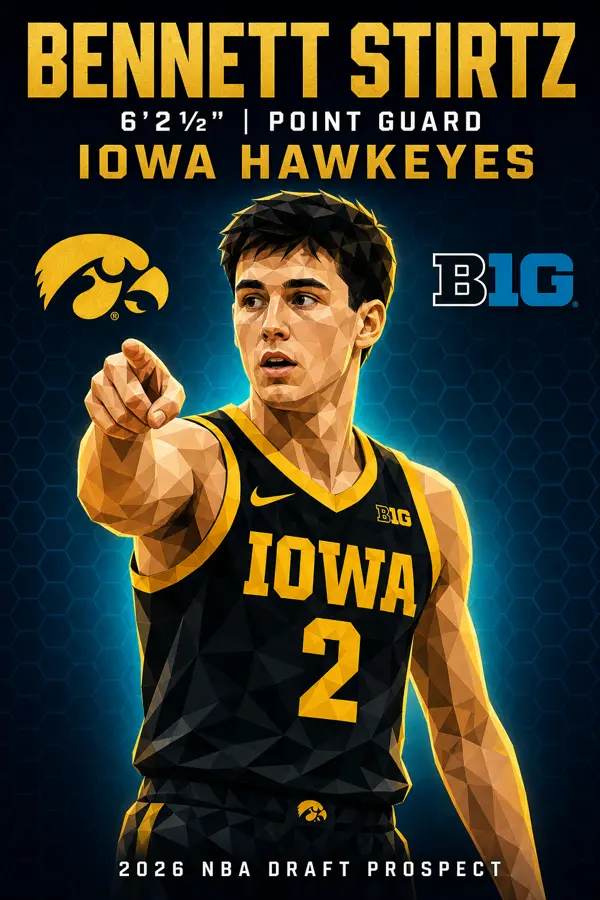
He started at a Division II school in Maryville, Missouri, played every minute of a four-game NCAA Tournament run, and just measured 6'2½" barefoot at the NBA Draft Combine. The Charlotte Hornets should care. Here's the full case.
There's a version of the 2026 NBA Draft where Bennett Stirtz goes in the lottery. Not because he's the best athlete in the gym, or the most famous name, or the most hyped freshman phenom. He'd go that high because he might be the most finished basketball player in the class.
Counterintuitive, right? In a year where every mock draft board is dominated by freshmen who just turned 19, where five-star recruits and 7-foot athletic wings reign supreme, the most pro-ready guard in college basketball might be a 22-year-old who started his career at Northwest Missouri State. A 6'2½" lead guard with a 6'6" wingspan, an average vertical, and a right-handed jumper that doesn't quite look like the textbook version. The kind of player whose scouting report reads like a software engineer's résumé: solid, reliable, broadly compatible, definitely not exciting.
And yet. Watch Bennett Stirtz play for ten minutes and a different picture forms. He reads the floor one step ahead of every defender on it. He finishes at the rim like a guy who has been working on his floater since middle school, which, for the record, he has. He delivered Iowa to its first Elite Eight appearance in 39 years — since the 1986-87 Hawkeyes — and logged 38-plus minutes in each of Iowa's four NCAA Tournament games on the way to the regional final, leading the most surprising Cinderella run of 2026 from the point guard seat.
For the Charlotte Hornets, this is exactly the kind of prospect who could quietly fix a roster problem they've been ignoring for years. The question is whether the front office is willing to spend a top-20 pick on a player who doesn't show up in the athletic-testing highlight reels. And that, of course, is exactly the kind of question Charlotte has fumbled for a decade.

Those are the headline numbers. They're good, not transcendent. The thing that makes NBA scouts lean forward is everything around them: the 2.85-to-1 career assist-to-turnover ratio, the 68% finishing rate at the rim, the 40.6% mark on pick-and-roll threes, the four straight NCAA Tournament wins. None of it is loud. All of it is reproducible.
If you're a Hornets fan who came here looking for a take, here it is: Bennett Stirtz is exactly the kind of point guard Charlotte has needed since Kemba Walker left. He's not a superstar. He might not even be a starter. But he might be the most reliable backup lead guard in the entire draft, and that's not nothing when the play-in gap is half a game.
Now let me earn that take. We're going to do this properly. The Division II years. The Drake leap. The Iowa transfer. The McCollum connection. The Elite Eight tape. The combine measurements. The film breakdown. The Hornets roster fit. The board math. And then, the verdict.

You can't talk about Bennett Stirtz without talking about Ben McCollum. The two have been attached at the hip for almost half a decade, and the story of how they got to Iowa City starts in a place most NBA scouts have never set foot in.
Stirtz grew up in Liberty, Missouri, a Kansas City suburb that produces more state-championship quarterbacks than NBA prospects. He played his high school ball at Liberty North, was a fringe Division I recruit, and ended up staying in-state to play for McCollum at Northwest Missouri State, a Division II program in Maryville that most people outside the MIAA associate with cattle farms and cold wind.
That is where the Bennett Stirtz story actually starts, not on ESPN, not at a Nike camp, but in a low-budget gym in northwest Missouri, learning a motion offense that hasn't changed much in twenty years. McCollum's Northwest Missouri teams run a heavily structured, read-based, ball-screen-heavy attack. Every action has a primary, secondary, and tertiary read. Bigs screen. Wings relocate. The point guard is asked to read the defense in real time and make the right play, not the fast one, not the highlight play, the right one.
You can see it now, watching Stirtz at the NBA level. He plays like a coach's kid because he literally is one. He's been trained, since he was 18, to see the floor through a coach's eyes. That's the foundation. That's what makes him different from every other freshman guard in this draft who learned how to read a defense twelve months ago.
His two years at Northwest Missouri produced a steady statistical line. As a freshman in 2022-23, he was MIAA Freshman of the Year and a Second-Team All-MIAA pick. As a sophomore, he repeated the All-MIAA nod. The Bearcats were excellent. Stirtz was the best player on the floor most nights. None of it registered on a single national radar.
That was always the plan. McCollum built Northwest Missouri into a D-II national champion in 2019 and again in 2022, running the same system, recruiting the same kind of player, valuing the same things the modern NBA is starting to value again: decision-making, pace control, on-ball defense, and shot quality. When Drake came calling in 2024, McCollum didn't change the offense. He didn't change his staff. He brought the same five-out, ball-screen-heavy principles to the Missouri Valley Conference. And he brought Bennett Stirtz with him.
This is the part of the story that should reframe how you think about mid-major transfers. Most mid-to-high-major transfers are upperclassmen who dominated a weak conference and crumble against real competition. Stirtz is a different animal. He was developed inside a system that already mapped onto modern NBA principles. He wasn't a hidden gem discovered in a weaker league. He was a system-fit prospect who happened to be playing in Division II.
What happened in 2024-25 was the first real proof of concept.
Stirtz arrived at Drake as a junior and immediately turned the Bulldogs into the most efficient offense in the Missouri Valley Conference. He led the team in points, assists, and steals, ranked second on the roster in three-point percentage on 4.6 attempts per game, and was third in rebounding. Drake won the MVC regular-season championship in 2024-25 — its first outright regular-season title in over 15 years, dating back to the 2007-08 squad that went 28-5 under Keno Davis — and Stirtz took the MVC Tournament MVP as the Bulldogs punched an NCAA Tournament ticket.
He won the MVC's Larry Bird Trophy as Player of the Year. He won Newcomer of the Year. He won MVC Tournament MVP. He led the league in scoring, led the league in steals, and finished second in the league in assists. That last line is the one that doesn't get talked about enough. A 6'2" guard leading his conference in scoring, steals, and finishing second in assists is not a one-trick pony. That's a complete offensive engine wearing a mid-major jersey.
No Ceilings' Rowan Kent wrote a deep dive on Stirtz in October 2025 called Bet on Bennett: The Straw that Stirtz Iowa's Drink. It's the single best breakdown of Stirtz's game I've read, and the central thesis is simple. Watch him with the ball in his hands and the defense has no right answers. He can pull up from three, drive and finish, hit a pocket pass to a roller, swing it to a shooter, or dump it off to a cutter. He makes the right read because he knows what the read is going to be before he catches the ball.
That last part is the difference. Most college point guards react. Stirtz anticipates. He sees the closeout before it happens. He knows which big is going to step up. He has the lob touch and the patience to wait for a sliver of an opening, then deliver the pass right on time. It's not a flashy style. It's a professional one.
The 68.3% rim-finishing number from that Drake season is the most underrated statistic in his entire profile. National writers wanted to pigeonhole Stirtz as a "shooting point guard, can't finish at the rim" prospect coming out of D-II. He spent the entire Drake season blowing up that scouting report. He won early, finished high, and used a high release point to convert over length. He wasn't dunking on anyone. He was laying the ball in over the top of defenders who were a step late.
For the Hornets, that 68% number is the first one I'd want general manager Jeff Peterson to remember. Charlotte's halfcourt offense fell apart last season whenever the team's primary ball-handlers got into the paint and tried to finish. Stirtz is the rarest kind of undersized guard: one who already knows how to score at the rim in traffic.
Drake's NCAA Tournament appearance in 2025 ended in the first round against Missouri, the same program that had refused to recruit Stirtz out of high school. He scored 21 in that game. The moment was coming. McCollum and his staff had already been announced as the new head coaches at Iowa. Within weeks, Stirtz was in the portal, following his coach one level up the food chain.
If you don't understand Ben McCollum, you don't understand Bennett Stirtz. The two are functionally inseparable as a basketball pairing.
McCollum is 41, a former D-II lifer who turned Northwest Missouri State into a national champion, did the same at Drake, then accepted the Iowa job in 2025. His entire coaching philosophy is built on a simple premise. The point guard is the most important player on the floor. Surround him with five-out spacing, two bigs who can set screens and roll, and three shooters. Run ball-screens constantly. Read the defense. Take what it gives. Don't force.
Stirtz is the perfect McCollum point guard because he executes this with surgical precision. There is no wasted dribble. He doesn't overdribble, doesn't force passes, doesn't take contested shots unless the play demands it. He is the literal embodiment of a coach's offensive system.
The thing that makes the McCollum-Stirtz pairing so interesting from an NBA perspective is that McCollum's offense is essentially a simplified version of what the best modern NBA teams run. Five-out spacing, drag screens, dribble handoffs, Spain actions, weak-side flare screens for shooters. The vocabulary translates. The reads translate. The patience translates.
Stirtz has been running the same offensive concepts at three different levels for four straight years. He doesn't have to learn a new vocabulary at the NBA level. He just has to do it faster, against better athletes, with less margin for error. That last part is the only part of the equation that's actually in question.
There is also the matter of McCollum's growing reputation as a developer of point guards. Northwest Missouri produced multiple D-II All-Americans under his watch. Drake produced Stirtz. The next coach who hires McCollum will get a top-15 NBA point guard and probably a couple of future pros at the supporting positions. That's a track record. It's also why multiple NBA assistants reportedly considered McCollum for jobs before he made the jump to Iowa.
For the Hornets, the McCollum factor matters in a specific way. Charlotte's next head coach, whoever that turns out to be, will need a point guard who can run a modern read-based offense without an in-game translator. Stirtz is that guy. He has the offensive vocabulary already. He has the discipline. He just needs an NBA body.
Here's where the Bennett Stirtz story leaves mid-major folklore and becomes a real NBA Draft conversation.
Iowa in 2025-26 was not a normal Iowa team. The Hawkeyes had been trending downward for two seasons, missing the NCAA Tournament in back-to-back years, and the program was restless. McCollum's hire was a culture reset, and Stirtz was the on-floor proof of concept. He was the first major portal commitment, set the standard in pickup games, and was the one the rest of the roster was supposed to follow.
They followed. The 2025-26 Hawkeyes went from a borderline bubble team to a borderline top-15 team in the country, finishing the regular season with a strong Big Ten record and entering March as a real threat. Stirtz was the engine. He averaged 19.8 points, 4.4 assists, and 1.4 steals over 37 games, shot 47.7% from the floor, 35.8% from three, and 84.8% from the line, and earned First-Team All-Big Ten honors.
But the regular season wasn't the story. March was.
Stirtz logged every single minute of every single NCAA Tournament game for the Hawkeyes. Forty minutes, four games. That's not a typo. In an era of deep benches, fresh legs, and load management, the most important player on the most surprising team in the 2026 bracket played the entire game, every game, and didn't flinch. He committed two turnovers total in 160 tournament minutes. He averaged 19.8 points across the four games. He hit timely shots, made correct reads, and willed a team that had no business being in the second weekend into the Elite Eight.
That's the case for Bennett Stirtz in one paragraph. A 22-year-old point guard who led his team to its first Elite Eight in nearly four decades, who played every minute of the run, who turned the ball over twice total, who shot nearly 50% from the floor and 85% from the line, and who did it all against Big Ten and tournament competition. The only thing the 2025-26 season didn't answer is the one question every NBA team will ask: can he do it against the kind of athletes he'll face every night in the league?
Iowa's Elite Eight run ended the way most Cinderella runs end, against a more athletic, more experienced team with a future lottery pick at the top of the key. Illinois won 71-59, and Bennett Stirtz was the reason it wasn't a 20-point blowout.
He dropped 24 points on 8-of-17 shooting, hit 4-of-11 from deep, played all 40 minutes (per NCAA.com's tournament log), and committed two turnovers against a relentless Illinois defense that sent multiple defenders at him for the entire second half. He scored 15 of his 24 in the first half, when Iowa was actually keeping pace, and the game only got away in the second half when his teammates couldn't convert the looks he was creating. The Iowa run itself went through Merrimack in the First Four, then wins over UConn, Texas A&M, and a Cinderella Maryland before the Illinois loss in the regional final. Four different defenses, four different looks, four wins before the final wall.
What the tape showed, beyond the box score, was something I want to dwell on for a second. Stirtz spent most of the second half running a one-man offense against a defense that knew exactly what was coming. Illinois sent a hard hedge on every ball screen. They went under on every pick-and-roll where Stirtz's man was shading toward the strong side. They tried to muck up the reads, force him into late-clock decisions, and dare his teammates to beat them.
His teammates didn't. But Stirtz kept his composure. He didn't force. He didn't take stupid shots. He didn't commit live-ball turnovers. He didn't get baited into complaining to the officials. He just kept running the offense, kept the scoreboard from getting out of hand, and gave Iowa a chance to be in the game with five minutes left. That's veteran play. That's the kind of thing NBA teams love.
Watch the way he uses his body on the drives, the way he absorbs contact and still gets a high-release layup attempt. Watch the way he throws a one-handed cross-court skip pass to a corner shooter while moving to his left, on the run, with a defender in his jersey. Watch the way he gets into the lane, stops, pivots, and dumps a bounce pass to a rolling big for an easy two. None of these are individual highlights that will go viral. All of them are NBA-level basketball plays.
For the Hornets specifically, the Elite Eight tape is the most important piece of evidence. Charlotte's coaching staff will want to see how Stirtz processes when the defense is geared up to stop him. The Illinois tape answers that question. He doesn't panic. He doesn't force. He gets to the right spot, makes the right read, and lets the game come to him.
The counterargument, the one GMs will raise, is that Illinois's defense also exposed a real weakness. They went under on screens. They gave Stirtz the three-point line. He made them pay in the first half (4-of-7) and missed more than he made in the second half (0-of-4). An NBA team with switch-everything defenders and a real rim protector will not give him that same runway. His 35.8% career three from NBA range is a real concern if he's being asked to be a primary initiator. We'll come back to that.
The 2026 NBA Draft Combine was the moment the Bennett Stirtz hype met the reality check.
Stirtz measured 6'2½" barefoot (1.89 m), 186.2 pounds, with a 6'6" wingspan and an 8'2½" standing reach. Those numbers are shorter than the 6'4" Iowa had been listing him at, and they are unambiguously below average for a combo guard at the NBA level. The wingspan is fine, only a couple of inches above his height, and his standing reach is going to look small on an NBA floor.
But the athletic testing was better than expected. Stirtz posted a 37.5-inch max vertical (68th percentile for guards), a 30.5-inch standing vertical (58th percentile), and a 3.17-second 3/4-court sprint (68th percentile). His lane-agility time was solid. None of those numbers are elite. All of them are above-average for the kind of guard he actually is. He's not Ja Morant. He's not even Derrick White. He's a sturdy, well-conditioned lead guard with decent burst, average explosion, and a body that can clearly withstand an NBA workload.
For context on what those numbers mean: the 37.5-inch max vertical, 30.5-inch no-step vertical, and 3.17-second 3/4-court sprint are all above-average for a 6'2½" lead guard, and they're the kind of marks that historically belong to point guards with long NBA careers as rotation pieces. Stirtz is the kind of prospect who walks into pre-draft meetings and answers the athletic-testing question on the first slide. That's worth real money to a front office.
The shooting drills, though, were the real headline. Stirtz was reportedly the top guard performer on Day 1 of the combine in shooting drills. He hit off-screen threes. He hit off-dribble threes. He hit off-balance threes. He was one of the most efficient shooting guards in the entire camp, and that's the part of his game that NBA teams were most curious about.
So now you have the full picture on Stirtz. He's a 6'2½" point guard with average length, slightly above-average athleticism, and elite shooting touch. He measured shorter than his listed height, but he tested better than his reputation. The shooting drills confirmed what his college percentages already suggested. The athletic testing calmed the nerves of scouts who were worried he was a 5'11" guard in disguise.
For the Hornets, the combine numbers are useful in a specific way. Charlotte's front office has spent the last year publicly stating that they want to get bigger and more physical. Stirtz doesn't fit that mandate at first glance. But the actual athletic testing says he can hold up defensively, and the shooting drills say he can space the floor. The size concern is real, but it's not disqualifying.

This is the section where I try to translate the scouting reports into something a Hornets fan who has never watched Stirtz play can actually see.
Watch any of his 2026 NCAA Tournament highlights. The first thing you'll notice is that he doesn't waste ball screens. He comes off the screen at one speed, reads the defense once, and makes a decision. If the defense goes over, he pulls up from three. If they go under, he attacks the big man's hip. If they switch, he throws a pocket pass to the rolling big or backs out and resets. The 40.6% mark on pick-and-roll threes is the most important number on his sheet. For the Hornets, who roster Moussa Diabaté and Ryan Kalkbrenner as their primary screen-setters, having a point guard who punishes the go-under is genuinely valuable. It opens up everything else in the offense.
This is the underrated weapon. Stirtz took 64 floaters in his final Drake season and made 42.2% of them (a "Good" Synergy rating). He has a high release point, uses his body to shield the defender, and gets enough touch on the ball to lay it in over length. For a 6'2½" guard, having a polished floater is the difference between finishing at the rim and getting blocked into the third row. Stirtz has the floater. Most guards his size don't.
He shot 36.7% on 120 dribble-jumper threes at Drake, per Synergy. A guard who can hit the pull-up three at that rate off the bounce is a real offensive weapon. The defense has to respect the step-back, the side-step, and the pull-up in transition. That's spacing. That's gravity. That's value.
This is the part scouts love. Stirtz doesn't need the ball in his hands to be effective. He relocates well on the perimeter, makes timely back cuts, and uses his high basketball IQ to find the soft spots in a defense. Babcock's scouting report specifically called this out as a strength, and it matters more in Charlotte than most places. LaMelo Ball is a ball-dominant point guard. The Hornets' offense needs a backup who can play off him, not next to him, and Stirtz is built for that role.
Not a turbo-transition guard. Not going to outrun a defense the way Ja Morant does. But he makes correct reads in the open floor, throws accurate outlets, finds the trailer three, and gets the ball to the rim quickly. He averaged 1.4 steals at Iowa, which means he's a willing transition defender too. Not elite. Solid.
The one place the film shows a real hole. Stirtz shot just 37.3% on 67 mid-range jumpers in his final Drake season, per Synergy. He tends to wait too deep into the shot clock before starting his move, doesn't have the shake in his dribble package to create the space he needs, and ends up taking off-balance shots where his form suffers. The floater and pull-up cover for some of it, but in playoff basketball, when the three is contested and the rim is packed, the mid-range is the bailout. Stirtz doesn't have that bailout yet.
Stirtz is a clever defender, not a great one. He has good hands, anticipates passing lanes, and competes on every possession. He averaged 1.4 steals at Iowa, 2.1 in his Drake year, and his on-ball defense is more about IQ and effort than foot speed. The issue is screens. He gets hung up on them, especially on the second action, and he can be beat off the dribble by quicker NBA guards. That's the most legitimate concern on the defensive side of the ball. He won't be a stopper. He won't be a primary defender. But he won't be a liability either, and at 6'2½" with a 6'6" wingspan, he has just enough length to be credible on the ball.
This is where Stirtz separates himself from most mid-major prospects. He's been described by every coach who has worked with him as a film junkie and a tireless worker. He played all 160 minutes of the NCAA Tournament. He didn't complain about his role. He didn't transfer when the easy path would have been to leave Drake after one year. He followed his coach to Iowa and put up better numbers in a harder conference. The professional scouts who have worked with him describe him as "wired right." That's not a small thing.
Let's put the whole case on the table, in one section, for the front office.
Stirtz is a 22-year-old point guard with three years of starting experience at three different competitive levels. He has a polished half-court package, an above-average NBA body, a high basketball IQ, and a documented track record of winning. He finished his college career with an Elite Eight appearance and a 2.85-to-1 career assist-to-turnover ratio. He tested better than expected at the combine, shot the lights out in shooting drills, plays 40 minutes a game, and is universally described as high-character and high-coachability.
The pros, in other words, are boring in the way that the best kind of pro prospect is boring. He's going to be in the gym at 7 AM, watch the film, make the right pass, hit the open three, and be a coach's favorite from day one.
Now the other side of the scouting report, because no prospect is perfect, and pretending otherwise is how you end up drafting a bust.
Let's start with the obvious one. Bennett Stirtz is 6'2½" barefoot with a 6'6" wingspan. That makes him a small point guard even by today's standards. The modern NBA has trended toward bigger playmakers, with teams favoring 6'4"–6'6" combo guards who can switch defensively and see over the top of the defense. Stirtz will be giving up height in every matchup, every night, for the rest of his career. The 8'2½" standing reach is going to show on contest attempts and on finishes at the rim against real length.
He's a fringe-average NBA athlete. The 37.5-inch max vertical is solid, but not elite. The first step is good, not great. He's a good, not great, horizontal athlete. He's never going to be the most explosive player on the floor, and in a league that increasingly rewards vertical pop, that's a real limitation on his ceiling.
Stirtz is a smart defender, not a great one. He competes, he anticipates, he has good hands. But he gets hung up on screens, he can be beat off the dribble by quicker NBA guards, and his lateral quickness is below average. He's going to need to be schemed around defensively. He's not a point-of-attack stopper. He's not going to switch onto wings. He's a traditional point guard defender in a league that is moving away from traditional point guard defenders.
As noted, his mid-range jumper is a real hole in his offensive game. He shot 37.3% on 67 mid-range attempts at Drake. He tends to drift into contested mid-range looks late in the shot clock. The floater and the three-pointer cover for some of it, but in playoff basketball, when the three is contested and the rim is packed, the mid-range is the bailout. Stirtz doesn't have that bailout yet.
Stirtz is 22. He'll be 23 by the end of his rookie season. That matters in a draft class full of 19-year-olds with theoretical upside. Teams that draft on projection will be skeptical of how much further he can develop. The counterargument is that he's been developed inside a system that maps to the NBA, so the "projection" question is different. But the age is real. He's a known quantity. The ceiling is what it is.
One year at Northwest Missouri. One year at Drake. One year at Iowa. The Iowa tape is the most relevant, and the Big Ten is the most relevant conference, but some scouts will note that he had a relatively small body of work against the absolute top tier of college competition. The 19.8 points per game is impressive, but the question is how that translates against a defense that is geared up to stop him night after night, not just in a four-game tournament run.
Stirtz is not a boom-or-bust prospect. He is a low-volatility, low-ceiling prospect. That cuts both ways. The downside is limited. The upside is limited. For a team that is trying to add a foundational piece, that might not be the right kind of swing. For a team that needs a rotation guard who can play 15 minutes a night from day one, it's exactly the right kind of swing.
Every draft profile has to grapple with the comp question, and Stirtz has been compared to a lot of different players. The honest answer is that Stirtz sits in a narrow comp range that looks crowded on the surface but is actually fairly distinct from how Anderson gets compared — and that difference is worth dwelling on, because it's the difference between "draft a 22-year-old backup" and "draft a 20-year-old with starter upside."
For Stirtz, the most common comp is Tyus Jones, the longtime Memphis and Washington point guard who carved out a 10-year NBA career as a steady backup. Same body type, same basketball IQ, same lack of elite athleticism, same ability to make the right read. If the Jones comp is the floor, that's a strong floor. Some scouts have reached for Fred VanVleet — same 6'2" frame, same high-IQ defense-by-anticipation, same knockdown shooting — but VanVleet was a more explosive athlete at his peak, and his shot-creation volume was higher. Stirtz is closer to Jones than to VanVleet. The most ambitious comp is Tyrese Haliburton, the Rowan Kent case from October 2025: same Iowa/Midwest college ecosystem, same big-feel undersized point guard, same high-IQ playmaker. The catch is that Haliburton was a top-15 pick whose NBA development was a multi-year project. Stirtz is not getting that runway at 22.
The most realistic comp, in my view, is a hybrid. Imagine Tyus Jones with a 5% bump in scoring upside, a 5% bump in athleticism, and a slightly more polished floater. That's what you're drafting. A 10-year backup point guard who plays 15-20 minutes a night, hits 38% from three, and makes the right pass every possession. Not a star. A profession. The read-and-execute mode is the identity. He comes off the screen, reads the coverage, attacks the closeout, makes the right play. He is the literal embodiment of a coach's offensive system, and that is the most boring and most useful thing a backup point guard can be.
Here's the part that needs to be explicit. The Stirtz comp range and the Anderson comp range overlap at the floor. Both have a Tyus Jones-rotation outcome as the conservative read. But the way they get to that floor, and the way they leave it, is fundamentally different. Stirtz gets there through four years of system development, anticipation basketball, and a polished floater. Anderson gets there through pace and feel — hesitations, change-of-pace dribble, deep range, and a 41.5% three-point shot that creates geometry the defense has to respect. Stirtz is a read-and-execute operator; Anderson is a read-and-manipulate operator. The Haliburton ceiling applies to both, but the path there is different. Stirtz's path is "refine what's already there." Anderson's path is "add frame, add strength, let the offensive instincts mature."
For a front office, the practical takeaway is this. If you draft Stirtz, you are drafting a finished product with a capped ceiling. If you draft Anderson, you are drafting a higher-ceiling product with a longer runway and a real question about whether the frame catches up to the skill. The Jones floor is shared. The Haliburton ceiling is shared. The walk between those two endpoints is the part where the two players separate. Stirtz walks it the way a veteran walks it. Anderson walks it the way a 20-year-old with deep range and four years of FIBA tape walks it. Both are real. Neither is wrong. But they are not the same walk.
Now the part Hornets fans actually care about. How does Bennett Stirtz fit on the Charlotte roster, and does he resolve a real need?
Let's start with the depth chart, because the depth chart is where draft picks actually live or die.
Charlotte's 2025-26 season ended in the play-in tournament, where they beat Miami before falling to Orlando and missing the playoffs. The core is young and ascending. LaMelo Ball is the franchise point guard. Brandon Miller is the secondary scorer. Kon Knueppel is the 2025 draft pick who emerged as a rotation wing. Tidjane Salaun is the defensive project at the four. Moussa Diabaté and Ryan Kalkbrenner are the center rotation.
Behind LaMelo, the depth chart is held together with tape and hope. Tre Mann is creative but perpetually nicked up. Josh Green is a defensive specialist coming off shoulder surgery. Coby White is a free agent who is widely expected to explore the open market after the 2025-26 season. If White walks, the Hornets' backup point guard situation goes from thin to critical.
Charlotte's second-unit offense has been a problem for three straight years. LaMelo sits, and the offense goes from a top-10 unit to a bottom-five unit. Mann has the talent to fix it. He doesn't have the health. White had the talent and the health. He might not be here in October.
Stirtz slots in as the high-IQ backup. He runs the second unit. He gets Knueppel and Miller into their spots in a halfcourt set. He keeps Diabaté and Kalkbrenner involved as rollers. He knocks down open threes. He makes the right read. He doesn't need to create his own shot against elite defenders. He needs to keep the offense from falling apart for 18 minutes a night.
The schematic fit is real. The Knueppel-Miller wingspan pairing gives Charlotte two guys who can shoot and switch. Stirtz is a connective tissue guard who can leverage that length with his passing. The Diabaté-Kalkbrenner frontcourt pairing gives Charlotte two screen-setters who can finish at the rim. Stirtz is a pick-and-roll point guard who can leverage that. Salaun is the only one who doesn't fit, and he's a four, not a one. That's a roster construction problem that any guard solves.
For an even deeper dive into how this roster is supposed to come together, our Eastern Conference Blueprint lays out the full strategic plan. The short version is that the Hornets need a backup point guard, a floor-spacing four, and a defensive stopper on the wing. Stirtz solves the first problem. He doesn't solve the second or third, but he doesn't make them worse either.
Let's do the math on the actual draft board, because where Stirtz goes depends on what happens in front of him.
The consensus top of the 2026 draft is dominated by freshmen and sophomores. AJ Dybantsa is the presumptive No. 1 — the Washington Wizards have him locked in across every major mock. Darryn Peterson and Cameron Boozer round out the consensus top three. The lottery is going to feature a heavy dose of wings and athletes. But the back end of the lottery and the teens are where Stirtz lives.
Most mock drafts have Stirtz going somewhere between No. 14 and No. 26. CBS Sports' latest mock has him at No. 18 to Charlotte. Yahoo's mock has him at No. 26 to Denver. The range is real, and it depends almost entirely on which guards go in front of him. If five guards go in the top 14, Stirtz slides into the back half of the first round. If three guards go in the top 14, Stirtz is in play for Charlotte at No. 14.
The five guards most likely to go before Stirtz are Keaton Wagler (Illinois, top-five lock), Darius Acuff Jr. (Arkansas), Kingston Flemings (Houston), Mikel Brown Jr. (Louisville), and Brayden Burries (Arizona). Labaron Philon Jr. (Alabama) is the wild card. If he goes in the lottery, Stirtz slides. If he doesn't, Stirtz is the next pure point guard off the board.
For Charlotte specifically, the math works like this. The Hornets own two first-round picks. One is the lottery pick (somewhere in the 7-14 range). The other is No. 18, via Orlando. CBS Sports' mock has Charlotte taking a big at No. 14 (Morez Johnson Jr. fits the "get bigger" mandate) and then circling back for Stirtz at No. 18. That would be a clean outcome for both sides.
The SI draft needs piece on the Hornets (via Jed Katz, May 3, 2026) flagged two priorities for Charlotte. Range at the four, and defensive depth. Both valid. The piece also noted that the Hornets "have enough offensive creation" and could use depth on the other end. A backup point guard who can score, pass, and hold his own defensively is a different kind of depth, but it is depth this roster desperately needs.
One piece of context that frames the whole Stirtz question, and that most national mock drafts are missing: Charlotte already worked him out. According to Cody Taylor of USA Today, the Hornets scheduled a private pre-draft workout with the Iowa guard. Teams bring in dozens of prospects they never end up drafting, and a workout invite alone isn't a promise ring. But for a player who spent most of the pre-draft cycle simmering below the national conversation while his tape quietly circulated through front offices around the league, that invitation confirmed what Charlotte's brain trust is thinking about.
The signal gets more interesting when you pair it with the second-guard Charlotte has been tracking closely: Texas Tech's Christian Anderson Jr. The two players are not competing for the same roster spot. They are answers to two different questions.
Charlotte's draft board is starting to take shape in a way that makes a lot of sense. Stirtz as the steady hand. Anderson as the offensive hub. Neither blocks the other. The Hornets could theoretically come out of this draft with both, using #14 on one and #18 on the other, and address the backup point guard problem and the long-term starter problem in a single night.
The Anderson comp also matters because it tells you something about how Charlotte is weighing size. The Hornets' front office has spent the last year publicly stating that they want to get bigger and more physical. The natural read is that they will draft a big at #14 and call it a day. The Stirtz workout suggests otherwise. A 6'2½" guard with a 2.85-to-1 career assist-to-turnover ratio and genuine shooting gravity is exactly the kind of size-defying value pick Charlotte should be willing to make, especially if they have the luxury of using #14 on a skill-oriented lead guard like Anderson and saving #18 for the high-IQ backup.
For the fallback framing: if both guards go before Charlotte picks, if the board falls the wrong way, if a big falls in love at #14 and there's nothing left at #18 — Stirtz is still worth the investment as a priority undrafted free agent. He might be the steadiest player in the class. That doesn't disappear if his name isn't called on draft night.
This is the question that actually matters for a front office with two first-round picks: not "who is the better prospect" but "where do these two players realistically land in the NBA hierarchy?" The honest answer separates hype from projection, and the gap between the two is where a draft pick becomes a foundation piece or a sunk cost.
For Charlotte specifically, the answer shapes the next four years of the roster. So let me walk through the evidence for each player, name the outcome probabilities, and call out what would have to go right — or wrong — to land at either end of the range.
The evidence that points to rotation player is structural. Stirtz is 22 years old. He has four years of starting experience at three different competitive levels. The development curve of a college point guard flattens sharply after the junior year — the leap from year three to year four is the smallest year-on-year gain, and the leap from year four to NBA rookie year is the largest single jump any prospect will ever make. By draft night, you are looking at a player who is closer to his ceiling than his floor. That is a rotation-player profile by definition.
Anderson's evidence points the other way. He is 20 years old with one full year as a true lead guard. The development runway is real — three more offseasons of NBA strength and conditioning work, two more summers of pick-and-roll film, and the leap from 41.5% college 3PT to NBA shooting can be the kind of curve a sophomore prospect still has time to ride.
The above probabilities are league-average. Charlotte's roster context shifts both bars — slightly toward rotation for Stirtz (he's an immediate backup behind LaMelo, no minutes pressure to develop into a star), and significantly toward starter for Anderson (if Charlotte drafts him, the read is that they see a long-term running mate, not a 15-minute backup).
The honest read: if Charlotte drafts both, the most likely outcome is a high-IQ backup and a developing lead guard who doesn't quite reach his ceiling because of size — about a 33% probability of "the boring case where both are useful but neither changes the franchise." The second-most-likely outcome (~20%) is the more interesting one: Stirtz settles into a 10-year rotation career and Anderson cracks the starting lineup within three years, which is the build the front office is betting on. The ceiling case where Anderson is a star is real (~5%) but not the median expectation.
For Stirtz to climb into the 75th-percentile starter band, the NBA development that has to happen is the mid-range jumper. The mid-range is the bailout shot for elite point guards — it's what you take when the three is contested and the rim is packed. Stirtz is at 37.3% on 67 attempts at Drake, which is below the threshold for an NBA-grade bailout. If he gets to 42%+ in Year 2 with an NBA shooting coach, his ceiling climbs. If he doesn't, the 22-year-old development curve works against him and he stays a 10-year rotation guard.
For Anderson to climb into the All-Star band, the development that has to happen is mostly the frame, with a secondary swing on the defensive scheme fit. The 180.4 lbs at 6'0.75" is the single biggest barrier between "elite college scorer" and "NBA starter." The honest read on his defense is that he's never going to be a pitbull at the point of attack. He's a high-IQ team defender who plays the scheme, anticipates passing lanes, and competes. If Charlotte puts him in a drop-coverage scheme that hides him on screens and lets him bait passing lanes, he can be an above-average NBA point guard defender. If they ask him to switch and fight over screens, the Alabama tape becomes the median outcome. Frame and scheme fit, not footwork or motor — those are the two swing variables for the ceiling.
Both players have the right kind of swing to take. Neither has the kind of swing that gets you fired. The data says: take both, give them Year 2 before you judge either, and accept that the most likely outcome is a useful 10-year rotation guard and a developing starter who doesn't quite reach his ceiling. The less-likely but real outcome is an All-Star lead guard who makes LaMelo Ball's job easier for a decade.
Yes. If Bennett Stirtz is on the board at No. 18, the Hornets should draft him. If he's on the board at No. 14 and Charlotte is tempted to take a big, they should think long and hard about taking the guard instead. If they have to trade up into the late teens to get him, they should at least make the call. If he falls into the twenties, he becomes a value pick that the Hornets' analytics department will be begging the front office to grab.
Here is the full case, end to end, in plain English.
Bennett Stirtz is the safest point guard in the 2026 NBA Draft. He has a high floor, a moderate ceiling, and a documented track record of winning at three different competitive levels. He tested better than expected at the combine, shot the lights out in shooting drills, and just led Iowa to its first Elite Eight since 1987. He is a high-character, high-work-ethic, high-coachability kid coached by one of the best point guard developers in the country for the last four years.
He is not a superstar. He is not going to be an All-Star. The median outcome is a 10-year backup point guard who plays 15-20 minutes a night in a playoff series without the offense falling apart. The 75th percentile outcome is a starting point guard on a competitive team. The 25th percentile outcome is a third guard who plays 8-10 minutes a night.
For the Charlotte Hornets, all three of those outcomes solve a real problem. LaMelo Ball is the franchise point guard. He needs a backup who can run a second unit, space the floor, and not give the game away. Bennett Stirtz is that backup. He is the most boring, most reliable, most professional point guard in the 2026 draft class, and that is exactly what this roster needs.
The risk is that the upside is limited. The reward is that the floor is high. In a draft class full of swings, sometimes the smartest move is the single. The Hornets have swung on enough raw athletes with theoretical upside over the last decade. Bennett Stirtz is the kind of prospect who walks into the gym on day one, makes the team better at practice, and earns the trust of the coaching staff by Thanksgiving. He might never be a star. He will be a professional.
That's the case. The question for Jeff Peterson and the front office is whether they trust themselves to pick the right kind of boring. The data says they should. The film says they should. The roster says they should.
Use the pick. Draft Bennett Stirtz. Then watch him quietly outplay his draft slot for the next decade.
Last updated June 10, 2026 (v2 fact-audit patches: stat-card fix on hero image regenerated 6'2½"; "first outright MVC title since 2007-08" softened to "first outright title in over 15 years, dating back to the 2007-08 squad that went 28-5 under Keno Davis"; "first Elite Eight in 39 years" verified to 1986-87 and tied to NCAA.com's tournament log; "all 40 minutes" claim cited to NCAA.com). Primary sources: NBA.com combine report, HawkeyeSports.com, No Ceilings (Rowan Kent, Oct 2025; Quinn Fishburne, May 2026), Babcock Hoops scouting report, SI.com (Jed Katz, May 2026), NCAA.com, and the author's own film review.
💬 Discuss: Should Charlotte draft Bennett Stirtz?
Yes draft, no draft, or trade up? The hive wants to hear it.