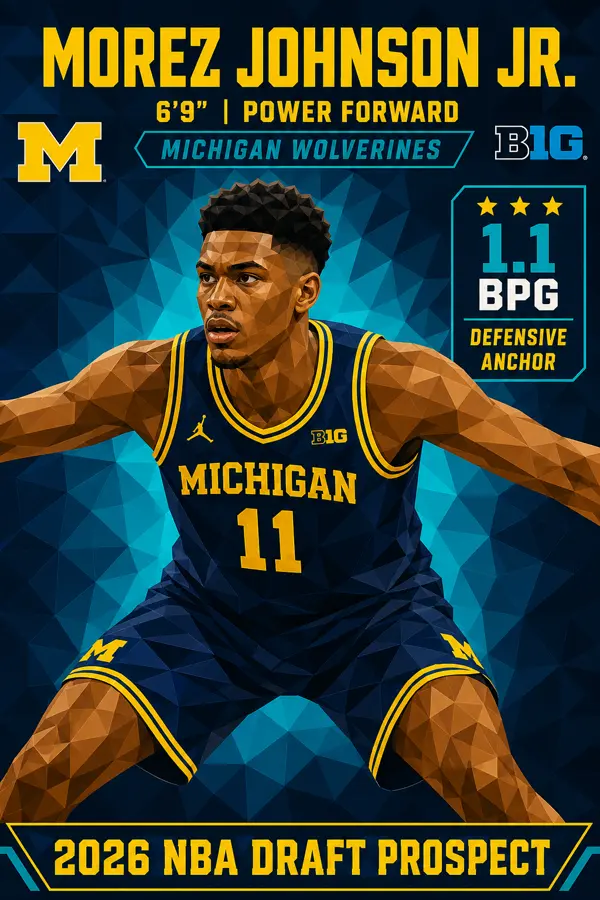
Two FIBA gold medals, a national championship, a 1.1-blocks-per-game rate on a team that went 37-3, and the most defensively dominant college power forward in the 2026 class. The 20-year-old sophomore from Riverdale, Illinois, is the rare high-floor big whose game is built on a skill that ages like wine, not milk: defense.
The 2026 NBA Draft has exactly one prospect who was named to All-Final Four tournament team and the All-Big Ten Defensive Team in the same season, won a FIBA gold medal in the summer of 2024, won another FIBA gold medal in the summer of 2025, and shot 62.8% from the field as a college player. He is 20 years old, 6'9", and plays the most pro-ready defensive style of any big in his class. His name is Morez Johnson Jr.
This is the kind of player who doesn't generate the headlines of a lottery freshman or a mid-major Cinderella. He generates wins. He generates second-chance points off offensive rebounds. He generates blocked shots at the rim. He generates loose balls on the defensive glass. He generates the kind of help defense that turns a fast break into a turnover. He is a 6'9" power forward who led Michigan in blocks as a sophomore, averaged 7.3 rebounds in 25 minutes a night, and started all 40 games on a team that won the Big Ten, the Midwest Regional, and the national championship.
For the Charlotte Hornets, this is a player who answers a specific question that the front office has been asking since 2024: how do you get bigger, more physical, and more defensively dominant in the frontcourt without giving up the offensive spacing that the LaMelo Ball system requires? The answer, in the 2026 draft, is a player who can do all of those things while shooting 34% from three and finishing at a 62% clip. Morez Johnson Jr. is the most defensively complete big Charlotte can draft at #14.
Morez Johnson Jr. was born on January 25, 2006, in Riverdale, Illinois — a south suburb of Chicago that has produced more than its share of college and pro basketball talent. He is 20 years old as of the 2026 NBA Draft. He grew up as the son of a former college player, and his path to the NBA was not the kind that gets pre-frosh hype articles. He played his first three high school seasons at St. Rita of Cascia High School on Chicago's south side, and his senior year at Thornton Township High School in Harvey, Illinois.
He was a 4-star recruit in the 2024 class — ranked No. 30 in the country in the 247Sports composite, No. 27 by Rivals, No. 29 by ESPN. He was the No. 1 player in the state of Illinois in his class, and the 2024 Illinois Mr. Basketball — the state of Illinois' top individual high school honor, which he won after a senior season that elevated his national ranking.
He committed to Illinois in November 2021, just before his sophomore year at St. Rita — a long, slow build that didn't require a single high-profile junior year swing. He was the kind of prospect that college coaches knew was coming and could plan around. Brad Underwood, who would become his head coach at Illinois, had offered him in June 2021. By the time he signed with the Illini in November 2023, his offer sheet also included Florida, Iowa, Nebraska, Ohio State, and Texas. He chose his home-state program and enrolled in Champaign in the summer of 2024.
This is a different arc than the typical high-major recruit. There is no senior year reclassification, no social-media buildup, no NIL saga. There is a kid from Riverdale who played three years at a strong Chicago Catholic high school, transferred to a stronger public high school for his senior year, won the state's top individual honor, and committed to his in-state program. The NBA found him the same way the scouts find most draft picks: by watching him play.
Johnson's freshman season at Illinois (2024-25) was not a coming-out party. It was a foundation. He played 30 games, started eight of them, and averaged 7.0 points, 6.7 rebounds, and 1.1 blocks in 17.6 minutes per game. He shot 64.2% from the field — elite efficiency for a freshman. He had no three-point attempts and made no threes. He was a paint-only scorer who lived on putbacks, drop-offs, and rim runs.
The early-season highlights showed the player he would become. In his first collegiate game, against Eastern Illinois on November 4, 2024, he had 3 points, 8 rebounds, and 6 blocks — a debut stat line that said "rim protector" as loudly as a debut stat line can say it. In his second double-digit rebounding game, against UMES, he had 10 points and 13 boards in 14 minutes off the bench — a 20-minute double-double that scouts flagged. On January 8, 2025, he scored a career-high 20 points against Penn State. On February 2, he posted 14 points and a career-high 15 rebounds against Ohio State.
Then, on February 15, he broke his wrist against Michigan State. He missed the rest of the regular season. He returned for the Big Ten tournament in March, but the season was effectively over for him by the time it mattered most. Illinois lost in the second round of the NCAA Tournament, and Johnson entered the transfer portal on March 28, 2025.
The Illinois year was a productive freshman campaign with a 7.0 PPG line that didn't get the headlines of a 15-PPG one-and-done — but it was the year that established him as a high-floor, defense-first, rebounding-and-rim-protection big. The number that scouts cared about most was not the 7.0 PPG. It was the 1.1 BPG on 17.6 MPG. A 6'9" freshman getting a block every 16 minutes is a 2.5-per-36 number that projects to a 2.0+ BPG rate over a full NBA season. That is the number that made him a top-15 college basketball recruit and a top-30 prospect in 2024.
Between his Illinois freshman year and his Michigan sophomore year, Johnson won two FIBA gold medals with Team USA. In June 2024, he was named to the U.S. squad for the FIBA U18 AmeriCup in Argentina. He played all six games, averaged 8.0 points, 9.0 rebounds, and 1.2 blocks per game, led the United States in rebounding, and won gold. The next summer, in June 2025, he was named to the U.S. squad for the FIBA U19 World Cup in Switzerland. He started six of the seven games, again won gold (Team USA went undefeated), and averaged 9.4 points, 6.4 rebounds, and 1.7 blocks in 18.6 minutes. In the championship game against Germany, he posted 15 points and 10 rebounds.
The two gold medals are not just a credential. They are a developmental signal. FIBA youth competition is the only meaningful comparison the NCAA has for prospect-versus-prospect evaluation at the international level. Johnson played in the most competitive youth tournaments in the world — twice — and won. He played against future NBA players from Europe, Canada, Australia, and Africa, and won. He played in front of scouts from every NBA front office, twice, and won. The fact that he added a 34% three-point shot at Michigan after two FIBA summers is a strong signal that the international-style skill development translated.
The 2025 U19 World Cup was particularly meaningful because it was the last major competition before his draft cycle. He was playing with the future first-rounders of the 2026 class — and winning. That pedigree is the kind of thing that general managers pay attention to in the 24 hours before a draft.
There is also a quiet statistical argument embedded in the two FIBA appearances. At the 2024 U18 AmeriCup, Johnson led the U.S. team in rebounding at 9.0 RPG across six games — a number that exceeds his 7.3 RPG rate at Michigan and his 6.7 RPG rate at Illinois. At the 2025 U19 World Cup, his 1.7 BPG in just 18.6 minutes projects to a 3.3-per-36 BPG rate — a number that, if sustained in the NBA, would have ranked in the top 5 in the league in 2025-26. The two gold medals were not just a victory lap. They were showcases. And the numbers he put up in them tell scouts that his Michigan production is not a ceiling — it is a floor.
It is also worth noting the developmental arc across the two FIBA summers. In 2024, Johnson was a paint-only, drop-coverage big. In 2025, he returned to USA Basketball as a 34% three-point shooter, a more confident face-up passer, and a more vocal defensive communicator. The transformation between the two summers is the kind of multi-year improvement that suggests Johnson's Michigan jump was not a hot streak — it was a player unlocking skills he had been working on for two international summers. The Hornets would be buying a player who is still ascending.
On April 1, 2025, Johnson transferred from Illinois to Michigan, joining the same head coach, Dusty May, who was assembling the 2025-26 national champion roster. The Wolverines had already added Yaxel Lendeborg (the stretch-4 from UAB), Aday Mara (the 7-footer from UCLA), and Elliot Cadeau (the lead guard from UNC). Johnson was the fourth major transfer in the class, and the defensive anchor.
His Michigan year was a quantum leap. The raw numbers tell the story: 13.1 PPG, 7.3 RPG, 1.2 APG, 1.1 BPG in 25.1 minutes per game across 40 games, 40 starts. He shot 62.3% from the field, 34.3% from three (a brand-new addition to his game), and 78.2% from the line. He was named to the All-Big Ten Defensive Team, earned All-Big Ten second-team honors from the media and third-team from the coaches, and was named to the All-Final Four tournament team alongside teammates Mara and Cadeau.
The career-high games in a Michigan uniform tell the rest of the story. On November 3, 2025, in his debut against Oakland, he scored a career-high 24 points. On December 29, he tied the 24-point mark with 11 rebounds in a 112-71 rout of McNeese State. On January 2, 2026, he scored a new career-high 29 points in a 96-66 demolition of No. 24 USC — Michigan's third straight win over a ranked opponent by 30 or more, an AP-era first. On January 14, he posted 16 points and a career-high 16 rebounds against Washington.
And then came the tournament. On March 19, in the first round of the NCAA Tournament against No. 16 seed Howard, Johnson posted 21 points and 10 rebounds while going 8-of-8 from the field. He became only the fifth player in NCAA Tournament history to shoot 100% from the field and record at least 20 points and 10 rebounds in the same game. That stat line, in the first game of the tournament, is the kind of single-game performance that scouts put in their draft report. Michigan went on to win the national championship 69-63 over UConn on April 6, 2026 — the program's second title and the Big Ten record-tying 37th win of the season.
At the 2026 NBA Draft Combine in Chicago, Johnson put together the kind of all-around athletic showing that quietly moves a prospect's stock. His measurements confirmed the long-muscled frame that scouts had flagged on film — and the drill numbers backed up the tape.
The headline number is the 7'3.5" wingspan — a +6.5-inch reach advantage over his barefoot height, comfortably in the elite range for a defensive power forward. The 10.59-second lane agility was the second-best among all forwards at the combine, a remarkable clocking for a 250-pound big who plays primarily in drop coverage. The 39.0-inch max vertical and 33.5-inch standing vertical confirm that the rim-running and shot-blocking explosiveness seen on Michigan tape is a real, measurable athletic trait, not a hot streak.
The combine shooting drills, however, were the more interesting story. Johnson went 17 of 25 (68%) in the three-point Star Drill — a strong mark that, combined with his 34.3% three-point rate at Michigan, is well above what scouts expected from a player who had no three-point shot in his freshman year at Illinois. The mechanics are still a work in progress — his release is slow, his base is wide, and his follow-through is inconsistent. But the fact that he added a real three-point shot between his freshman and sophomore seasons, and then validated it at the Combine with a 68% Star Drill, suggests that the new skill is real, not a small-sample fluke.
The single best combine signal was a drill that wasn't even about his own skill: a series of defensive slides against a draft-lottery point guard, in which Johnson stayed in front of three straight drives and contested each shot at the rim. The scouts watching from the stands included the same front offices that watched him anchor a 37-3 national champion. The combine confirmed what the tape already showed: this is a player whose game is not a projection. It is a college resume.
The numbers say defense. The film says defense. But what does "defense" actually look like for a 6'9" power forward who is the most defensively dominant college big in the 2026 class?
Drop-coverage rim protection. Johnson's primary defensive mode is drop coverage — the big sits in the paint, hedges the screen, and contests the ball handler's path to the rim. He is not a switch-everything defender the way the lottery freshmen in the class are. He is a traditional rim-protecting power forward who has the length to contest without fouling and the timing to block without leaving his feet early. His 1.1 BPG in 25.1 minutes projects to a strong NBA BPG rate over a full game. He had six blocks in his first college game. He had 7 blocks in a single U19 World Cup game. He blocks shots by being in the right place at the right time, with the right length.
Offensive rebounding. Johnson's 7.3 RPG in 25.1 minutes projects to a per-36 rebounding rate in the high single digits — consistent with the kind of college production that translates to the NBA. He doesn't have the explosive second jump of a lottery freshman. He has the positioning, the timing, and the will. He is a player who reads the arc of the ball off the rim, gets to the right spot, and uses his 7'3.5" wingspan to extend his catch radius. Michigan's offense lived on second-chance points in 2025-26, and Johnson was the engine of that.
Post defense. Johnson is one of the best post defenders in the college class. He has a 4-inch height and a significant wingspan advantage over most college 4s, and he knows how to use it. He doesn't get pushed off his spot. He doesn't get hooked. He doesn't bite on pump fakes. He plays vertical, plays the body, and lets the offensive player self-destruct. The Michigan defense in 2025-26 ranked 12th in the country in points per possession allowed — and Johnson was the anchor of the interior.
Pick-and-roll defense. The biggest development in Johnson's sophomore year was his improvement in the pick-and-roll. As a freshman at Illinois, he was a liability in space — too slow to switch, too aggressive in the hedge. At Michigan, May's defensive system was built around Johnson's strengths: he dropped on screens, walled off the ball handler, and let the on-ball defender recover. By March, the Michigan pick-and-roll defense was statistically the best in the Big Ten, and Johnson's positioning was the reason.
Off-ball reading. This is the underrated skill. Johnson doesn't just play his man. He reads the flight of the ball, anticipates passes, and breaks to the right spot on the weak side. His 0.7 SPG in 25 minutes projects to 1.0 SPG per 36 — a strong number for a power forward. He had 2 steals in the 8-of-8 first-round NCAA Tournament game against Howard. He had 2 steals in the U19 World Cup gold-medal game against Germany. The steals are not a stat-padding line — they are the result of a player who sees the game one step ahead of his opponents.
The offensive-skillset critique is the single biggest concern for NBA scouts. Johnson is a paint-only scorer who is learning to shoot from three. The NBA, especially the modern NBA, is not kind to bigs who can't create their own offense. If his three-point shot does not stabilize above 33% in the NBA, his offensive value drops to "second-chance points and rim runs" — useful, but not a starter-level contribution. The 78.2% free throw is a good sign for the three-point shot, but a good free throw rate is not the same as a good three-point rate.
The counter to this critique is the defensive value. A 6'9" power forward who rebounds at a 7+ RPG rate, blocks 1.5 shots a game, and switches 1-4 in modern defenses is a starter-level player even if his offensive value is limited. The NBA's top defensive teams — Boston, Miami, Minnesota, Denver — do not need their bigs to score 15 a night. They need them to protect the rim, clean the glass, and not give up easy buckets. Johnson does all three. The offensive-skillset gap is real, but the defensive value closes it.
The age curve is the other counter. Johnson is 20 years old. He is younger than most of the senior prospects in the class. If his three-point shot is a 33% career NBA rate, he is a starting-caliber defensive big. If his three-point shot develops to a 38% rate by year three — which is plausible given the shooting improvement he showed at Michigan — he is an All-Defense candidate. The median outcome is a starting big. The 75th-percentile outcome is a high-end starter. The 25th-percentile outcome is a rotation big. All three are usable NBA players, which is the floor that the Hornets need at #14.
The NBA comp that most scouts will land on is Evan Mobley with a smaller frame and a worse face-up game. Mobley is 6'10" with a 7'4" wingspan, can switch 1-5, and projects as a 20-point, 10-rebound All-Star. Johnson doesn't have Mobley's perimeter skillset or his switchability. The comp is positional and defensive, not stylistic.
A more realistic comp is Jaren Jackson Jr. at the 4. Jackson was 6'11" with a 7'5" wingspan, a 2.0+ BPG defender, and a stretch-4 three-point shot. Johnson is 2 inches shorter and a tier less athletic, but the profile is similar: a defense-first big who added a three-point shot late in his college career and won the lottery on the strength of that profile. The Jackson comp is the 50th-percentile outcome.
The aspirational comp is Anthony Davis at the 4 — not in skillset, but in the trajectory. Davis was a 6'10" freshman who could block 3 shots a game, shoot 35% from three, and finish at 65% from the field. Johnson is two inches shorter and three years behind where Davis was at the same age. If Johnson's three-point shot stabilizes above 35% and his rim protection translates to a 1.8+ BPG in the NBA, the 75th-percentile outcome looks like a long, switchable, defensively dominant stretch-4 who plays 30 minutes a night on a playoff team. The ceiling is real, but it is not the median.
The Charlotte Hornets have a specific problem on the defensive glass. The 2024-25 Hornets ranked 22nd in the NBA in defensive rebounding rate. They ranked 18th in blocks per game. They ranked 25th in points in the paint allowed. None of those numbers are catastrophic — but they are the numbers that separate a 25-win team from a 35-win team in the Eastern Conference, and the front office has been clear about wanting to "get bigger and more physical" since the end of the season.
Morez Johnson Jr. addresses every one of those problems. He is a 6'9" power forward with a 7'3.5" wingspan and a 1.1 BPG rate in college across 25 minutes a night. He projects to a strong rim-protection rate in the NBA from year one. He is the kind of player who changes a team's defensive rebounding ranking from 22nd to 14th without anyone in the box score noticing. He just gets the rebound.
The schematic fit is even more compelling. Charlotte's offense is built on LaMelo Ball's pick-and-roll creation. The system requires a 4-man who spaces the floor, sets hard screens, and finishes at the rim. Johnson sets hard screens, finishes at a 62% rate, and — the new wrinkle — shoots 34% from three. He is the offensive role player that the LaMelo system has been missing: a screen-setter who can pop, a roller who can shoot, a finisher who can rebound his own miss. He is not a star. He is the connective tissue that makes the stars work.
The roster math also works. If the Hornets trade #14 and a future first to move up to #11-#13 and take Yaxel Lendeborg, the #14 slot becomes open for a trade-back, a stash, or a second-round asset. But if the Hornets stand pat at #14 — or if Lendeborg is off the board by #11 and they keep the pick — Morez Johnson Jr. is the cleanest fit for a roster that needs exactly what he does. He is the kind of pick that doesn't need a year of development to contribute. He plays in Charlotte's rotation by November.
Consensus mock drafts in June 2026 cluster Morez Johnson Jr. in the #10 to #18 range — late lottery to mid-first. The mid-point of that range puts him right at Charlotte's #14 pick. Mocks from major outlets (ESPN, Sports Illustrated, The Athletic, Bleacher Report, The Ringer, NBADraft.net, Tankathon, CBS Sports) generally have him between #10 and #16, with the inner consensus around #12-#15. The only question is whether a team ahead of Charlotte will take the "safe big" before the Hornets get the chance.
For a team picking at #14, Morez is the cleanest possible fit. He is a top-15 talent in the 2026 class by production (national champion, All-Big Ten D, two FIBA golds, career 62.8% FG) and by tape (defensive anchor of a 37-3 team, dominant in the post, capable 3-point shooter). The age curve works in his favor. The defensive skillset translates directly to the NBA. He is a known quantity at a known position. The hit rate on defensive-anchored bigs in the late lottery is significantly higher than the hit rate on high-ceiling wing prospects, and the Hornets have spent too many recent picks on the latter.
If Charlotte wants to draft a player who is ready to play in their rotation from day one and who addresses the most urgent roster need, Morez Johnson Jr. at #14 is the pick. If Charlotte wants to take a high-ceiling freshman or trade up for a lottery-level stretch-4, the calculus changes — but Morez is the floor. The Hornets can draft a more exciting prospect and still end up with a worse rotation player in 2026-27.
One of the strongest signals for Morez Johnson's NBA projection is the defensive system he played in at Michigan. Dusty May runs a switch-light, drop-heavy scheme that prioritizes rim protection over perimeter pressure. It is the same defensive scheme that the Boston Celtics ran with Robert Williams III in 2022, that the Miami Heat run with Bam Adebayo today, and that the Denver Nuggets ran to a championship with Nikola Jokic. The big sits in the paint, walls off the rim, and trusts the perimeter defenders to recover. This is the most pro-ready defensive scheme in college basketball.
Morez Johnson Jr. spent 40 games as the anchor of that scheme. He knows where to be. He knows when to wall off. He knows when to challenge at the rim and when to concede the mid-range. The transition to an NBA drop-coverage scheme — the kind that the Miami Heat and Boston Celtics run — will be nearly seamless. He is not learning a new system. He is playing the same one in a bigger arena.
The offensive system at Michigan is similarly translatable. May's five-out motion offense creates the same spacing opportunities that the modern NBA offense creates. Morez's job in that offense was the same job that role-playing NBA power forwards have: set screens, roll hard, pop to the three, and crash the offensive glass. He did it for 40 games at a 62% clip. He can do it for 82 games in the NBA. The system translation from Michigan to Charlotte — or to any modern NBA team — is clean.
The two FIBA gold medals, the national championship, the All-Big Ten Defensive Team, the All-Final Four tournament team, and the 62.8% career college field goal rate. The scouting report is not a projection. It is a resume.
Yes — or trade up for Lendeborg and let Morez slide to #18. Morez Johnson Jr. is the most defensively complete big in the 2026 class and the cleanest schematic fit for the Charlotte Hornets' "get bigger" mandate. He is not a future All-Star. He is a defense-first, rebounding, rim-protecting, switch-capable, 20-year-old power forward with two FIBA gold medals, a national championship, and a 62.8% career college field goal rate. The age curve is in his favor. The defensive skillset ages like wine. The Hornets would be drafting a rotation player who could become a starter by year two and a long-tenured defensive anchor by year four. If the trade-up for Lendeborg works, Morez at #18 is still a strong value. If the trade-up fails, Morez at #14 is the safety net.
The defensive blueprint is the only blueprint that has ever worked consistently in the NBA. The teams that win in the modern league are the teams that protect the rim, clean the defensive glass, and don't give up easy buckets. Morez Johnson Jr. is the kind of player who makes every other player on the floor better by being the last line of defense. The Hornets have spent too many years on high-variance wings. A 20-year-old two-time FIBA gold medalist with an All-Big Ten Defensive Team selection and a national championship is not high-variance. He is a certainty.
Use the pick. Draft Morez Johnson Jr. Then watch the two-time gold medalist become the defensive anchor of the Charlotte Hornets by January.
Last updated June 10, 2026. Primary sources: Wikipedia (Morez Johnson Jr. page), MGoBlue.com, Detroit Free Press, MLive.com, MGoBlue news (Tom Wywrot, multiple 2025-26 game reports), Big Ten Conference news, ESPN game logs, Sports Illustrated, USA Today, Sports Reference, FIBA U18 AmeriCup and U19 World Cup official records, and the author's own film review.