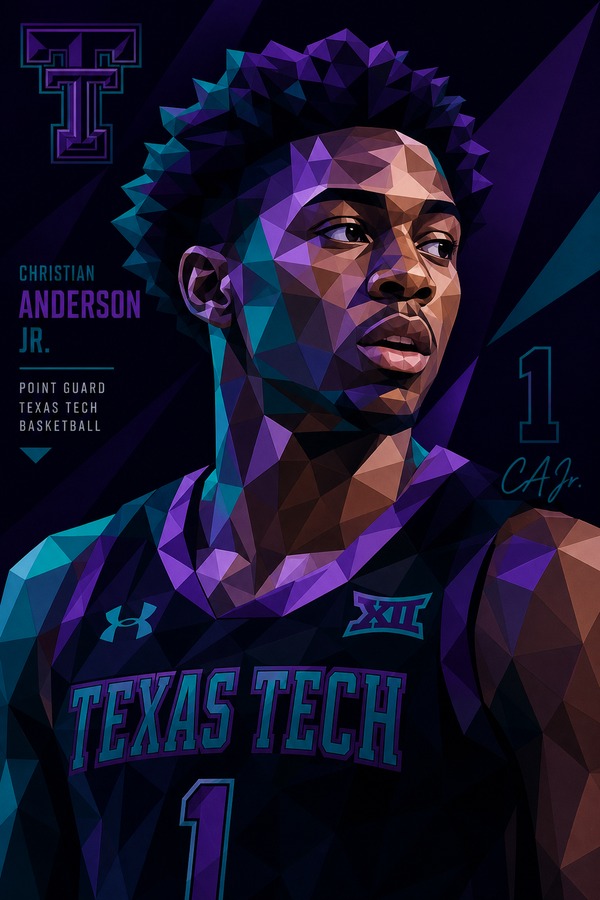
He led the Big 12 in assists as a 20-year-old, dropped 27 on Duke at Madison Square Garden, set a Texas Tech record, and posted a 40.5-inch max vertical — the highest of any point guard measured at the 2026 Combine. The mock draft has him at #16 to #22. The tape says that's wrong. Here's the full case.
There's a version of the 2026 NBA Draft where Christian Anderson Jr. goes in the top 10. Not because he's the most hyped guard, or the biggest name, or the prospect with the loudest agent. He goes that high because when you put his sophomore season side-by-side with the pre-draft seasons of recent lottery lead guards, his production ranks near the top of almost every meaningful category. He out-produced them on volume. He matched them on efficiency. He did it at 20, in the toughest conference in college basketball, in his first year as a true lead guard.
Counterintuitive, right? In a draft class where the lottery is dominated by 19-year-old freshmen, where every mock draft treats "youngest" as a tiebreaker, and where the public conversation is still trying to figure out if a 6'0.75" point guard can hold up at the NBA level, Anderson is the prospect whose case improves the deeper you dig.
He measured 6'0.75" barefoot at the combine. He weighed 180.4 pounds. He posted a 40.5-inch max vertical, the highest of any point guard measured at the 2026 Combine in Chicago (per NBA.com combine data). His wingspan came in at 6'6.25", a +5.5" positive differential that ranked 16th among all guards. He led the Big 12 in assists at 7.4 per game. He shot 41.5% from three on 108 made threes. He set the Texas Tech single-season assist record with 244 dimes (per TexasTech.com). He earned First-Team All-Big 12, Big 12 Most Improved Player, and Third-Team All-American. He played 38-plus minutes a night. He took the team to the Round of 32, beat Akron, then ran into Labaron Philon and Alabama.
And the mock drafts have him at #16 to #22.
For the Charlotte Hornets, this is exactly the kind of prospect who can change a franchise's ceiling in a single draft. The question is whether the front office is willing to be aggressive enough to get him.
Those are the headline numbers. They're elite. The thing that makes scouts lean forward is everything around them: the 244 assists (a Texas Tech record), the 1.5 steals per game, the German international pedigree, the 96% of available minutes played, the FIBA U19 World Cup silver medal and the All-Star Five honors, the U18 EuroBasket gold and the 31 points he dropped on Serbia in the final. None of it is quiet. All of it is reproducible.
If you're a Hornets fan who came here looking for a take, here it is: Christian Anderson Jr. is the most underrated point guard in the 2026 NBA Draft. He's not the safest. He's not the most athletic. He's the one with the highest ceiling on a roster that needs a long-term LaMelo running mate, and the one the public scouting conversation is most likely to get wrong. If Charlotte can get him at #18, that's a steal. If they have to trade up to #14 to make sure they get him, that's a trade worth considering.
Now let me earn that take. We're going to do this properly. The Atlanta childhood. The Oak Hill pedigree. The German international jersey. The freshman year nobody noticed. The sophomore explosion. The Duke game at the Garden. The McCasland system. The tournament run. The combine. The film. The comps. The Hornets fit. The board math. And then, the verdict.
You can't talk about Christian Anderson without talking about the German basketball system, the Oak Hill pedigree, and the recruiting odyssey that almost sent him to Michigan. The story of how he ended up at Texas Tech starts with a father who played professional ball in Germany and a son who grew up straddling two basketball cultures.
Anderson was born on April 2, 2006, in Atlanta, Georgia. His father, Christian Anderson Sr., was a pro basketball player in Germany, and the family maintained deep ties to the German basketball federation throughout Christian Jr.'s youth. He attended the Lovett School in Atlanta, one of the city's elite private schools, before transferring to Oak Hill Academy in Mouth of Wilson, Virginia, for his final two high school seasons.
Oak Hill is the Harvard of prep basketball. The alumni list reads like an NBA All-Star roster — Carmelo Anthony, Kevin Durant, Rajon Rondo, Tyus Jones. Anderson arrived as a four-star recruit with NBA-level footwork already in his bag and left as one of the most decorated scorers the EYBL Scholastic Circuit had ever seen. His senior-season Synergy splits were absurd: 20 PPG, 4.9 APG, 54.1/48.9/84.6 shooting splits, 97th percentile in pick-and-roll ball-handler possessions as the scorer (1.043 PPP), 94th percentile in spot-up efficiency, 45.8% on threes off the dribble, 62.7% at the rim. He dropped 20 points on Cooper Flagg and Montverde in a nationally televised prep showcase. By the time he graduated, he was a consensus top-50 recruit with two FIBA gold medals and a silver medal already in his trophy case.
For the international context, this is the part of the story that scouts underrate and that GMs should care about. Anderson has represented Germany at the U16, U18, and U19 levels, and he has medaled in every single event he's played in. The 2022 U16 European Championship Division B MVP in Bulgaria. The 2023 U18 European Championship bronze in Serbia. The 2024 U18 EuroBasket gold in Finland — their first-ever at the event, and Anderson dropped 31 points on defending champion Serbia in the final. The 2025 U19 World Cup silver in Switzerland, where he averaged 17.3 points, 6.6 assists, and 4.9 rebounds and earned a spot on the tournament All-Star Five.
In the U19 World Cup gold medal game against the United States, he put up 18 points, 9 assists, 4 steals, and 5 rebounds. Against a USA backcourt that included multiple future lottery picks. That's not a "system guard." That's a player who has been performing on the biggest stages in international basketball for four straight years and has only gotten better.
He was also called up to the senior German national team for EuroBasket 2025, an unusual honor for a 19-year-old. He's a long-term piece of their senior program, and his international track record is one of the deepest in this draft class.
The first year at Texas Tech, in 2024-25, didn't look like a star turn on the box score. It looked like the slow, patient development of a teenager in a system that didn't ask him to carry the offense yet.
Anderson averaged 10.6 points, 3.0 rebounds, and 2.2 assists in 35 games as a freshman. He shot 42.9% from the floor and 38.0% from three on 5.3 attempts per game. He made 71 threes. He earned All-Big 12 Freshman Team honors. Texas Tech went to the Sweet 16, and Anderson had a 22-point performance against Arkansas in the tournament (3-of-3 from three, 5-of-5 from the line). He was trusted by Grant McCasland to close games, and he played 31-plus minutes a night through the postseason.
But the counting stats don't tell the story. The story is what the tape showed. As a freshman, Anderson was already operating with NBA-level footwork in the pick-and-roll. He was already ambidextrous on the catch, hitting cross-court skips with his off hand. He was already showing the change-of-pace dribble and the soft touch on the floater that have become his calling card. The freshman numbers were a function of role, not a ceiling.
What separated Anderson even as a freshman was his decision-making. He averaged 2.2 assists against just 1.0 turnover, a 2.2-to-1 ratio that is elite for a teenage point guard playing in a major conference. He wasn't forcing. He wasn't jacking. He was reading, processing, and making the right play, even if the right play was giving it up to a teammate in a better position. That poise is what McCasland was building around.
The other thing the freshman year showed was his defensive effort. He competed on every possession, stayed connected to the team defensive scheme, and stayed out of foul trouble in a way that few freshman guards manage. He played 96% of available minutes as a sophomore, 90% as a freshman. He never gets tired. He never gets in foul trouble. He never takes possessions off. Those aren't freshman traits. Those are professional traits, learned in a professional system. But the more honest read of the freshman tape is that the effort was high and the results were schematic — Texas Tech's drop-coverage ball-screen scheme hides a lot of on-ball size issues, and Anderson was a smart, available piece inside it. He wasn't asked to be a point-of-attack disruptor as a freshman. He won't be asked to be one in the NBA either.
What happened in 2025-26 was the announcement.
Anderson's role changed. Texas Tech handed him the offense, told him to be the lead guard, and watched him become one of the best point guards in college basketball. He averaged 18.5 points, 3.6 rebounds, and 7.4 assists per game. He led the Big 12 in assists and finished fifth nationally. He set the Texas Tech single-season record with 244 assists. He shot 47.2% from the floor, 41.5% from three on 108 made threes, and 80.5% from the free-throw line. He earned First-Team All-Big 12, Big 12 Most Improved Player, and Third-Team All-American (AP, TSN, USBWA).
He scored 34 against Lindenwood in the opener, 31 against Cincinnati, 27 against No. 3 Duke at Madison Square Garden in the Champions Classic, 26 against Arkansas. The Duke game is the most-watched college basketball game of the early season and the kind of national-TV moment that scouts remember. He scored in volume, he scored efficiently, and he scored in every way — pull-up three, step-back mid-range, floater, layup, free throws.
The shooting is the part that scouts will project forward. A 41.5% three-point shooter on 108 made threes is a high-volume, high-efficiency season that translates to the NBA. The 80.5% free throw mark is the historical indicator that the three-point shooting is real. The 260 three-pointers he made over his two college seasons, at a 41% clip, is the kind of sample size that NBA shot-profile models love.
And the assists. 244 of them, at a 2.4-to-1 assist-to-turnover ratio. The only major-conference point guard in the country who did more with the ball in his hands was whoever ended up winning National Player of the Year. Anderson wasn't a stats-padder. He was the engine of a top-15 team that ran pick-and-roll 60% of the time, and he made it work.
Texas Tech finished the regular season ranked in the top 15, earned a 5-seed in the NCAA Tournament, and went one game deep into the bracket. Anderson was a major reason for all of it. The jump from 10.6 PPG to 18.5 PPG, from 2.2 APG to 7.4 APG, from All-Freshman to First-Team All-Big 12 — that's not normal sophomore development. That's a player who has figured out something the rest of the class hasn't.
Christian Anderson's sophomore leap happened inside one of the most NBA-style offensive systems in college basketball. Grant McCasland is one of the best offensive coaches in the country, and his Texas Tech scheme is built on the same set of principles that the best modern NBA teams run: five-out spacing, drag screens, dribble handoffs, weak-side flare actions, and a heavy dose of pick-and-roll initiated by the lead guard.
McCasland's system is essentially a simplified version of what an NBA team running drive-and-kick basketball wants to run. Bigs screen. Wings space. The point guard is asked to read the defense, attack the closeout, and either score or find the open man. The vocabulary translates. The reads translate. The patience translates.
Anderson is the perfect McCasland point guard because he executes the philosophy with the same surgical precision that Bennett Stirtz executes Ben McCollum's offense at Iowa. There is no wasted dribble. There are no contested pull-ups early in the shot clock. There is no overdribbling. There are no bailout passes into traffic. He plays the offense the way it is drawn up, and when the defense adjusts, he has the footwork, the touch, and the vision to punish the adjustment.
He was the offense, in a way that very few college point guards can claim. That's significant because NBA scouts aren't projecting him based on potential usage. They can watch him actually carry a top-15 offense, night after night, against the toughest schedule in college basketball. The NBA is just a bigger stage with longer athletes.
The flip side is that this is a McCasland system, and McCasland's system has produced a lot of good college guards who became middling pros. The film says the opposite. The FIBA track record says the opposite. The sophomore leap says the opposite. But the system is part of the context.
Watch the 2025 Champions Classic tape. Texas Tech vs. No. 3 Duke, at Madison Square Garden, on the opening week of the season. It was the most-watched college basketball game of the early season and the first real look most NBA scouts got at the new-look Texas Tech offense.
Anderson dropped 27 points in that game. He hit multiple threes off the bounce, finished at the rim through contact, and made the right pass on every possession where the defense committed to stopping him. Duke threw different looks at him. They blitzed the pick-and-roll. They went under. They switched the screen. They trapped in the halfcourt. None of it worked. He read the coverage, used his footwork to create separation, and either scored or set up the open man.
What the Duke game showed is the thing the No Ceilings scouting report captured in one line. Anderson is the best pick-and-roll guard in this draft. The deceleration off the screen, the patience to read the help, the touch on the floater, the body control to finish at the rim against length — these are the things that don't show up in the box score but show up on the film.
It also showed the concern. Duke's length bothered him on a few possessions. He was blocked once at the rim when he tried to finish over a 6'10" shot-blocker. The pattern is clear. He can do it in the NBA too.
Texas Tech's 2026 NCAA Tournament lasted two games. A 91-71 win over Akron in the first round, then a 90-65 loss to 4-seed Alabama in the Round of 32.
Against Akron, Anderson was the conductor. He controlled the tempo, picked apart the Zips' zone with his passing, hit timely threes off the bounce, and finished with one of his most efficient scoring nights of the season. Texas Tech as a team shot the lights out, and Anderson's 91-point team offensive output was a testament to the pace he set. He didn't need to score 30. He just needed to make the right read, and the offense flowed.
He shot 2-of-11 from the field, turned it over five times, and never found the rhythm that had defined his sophomore season.
The Alabama game is the single most important piece of tournament tape for any NBA scout evaluating Anderson. It told the truth. Against elite length, his size becomes a real factor. He can't get his floater over a 6'10" shot-blocker. He can't see over a defense that switches every screen. He can't finish at the rim through a contest that he would have finished through in the Big 12.
For the Hornets, the Alabama tape is exactly the kind of honest film they need to evaluate him. He's not going to dominate against every NBA team. He's going to have nights where the length bothers him. He's going to have nights where the supporting cast doesn't show up and he can't carry the team by himself. The question is how often those nights come. The answer, based on the Big 12, the Champions Classic, the FIBA track record, and the Duke game, is not very often.
The 2026 NBA Draft Combine was the moment the Christian Anderson hype met the reality check. And the reality check came out looking better than anyone expected.
Anderson measured 6'0.75" barefoot, 180.4 pounds, with a 6'6.25" wingspan and an 8'0.5" standing reach. Those numbers are short by NBA standards. The height is below the average for a combo guard. The weight is on the light side. The standing reach is middle-of-the-pack.
But the athletic testing was a different story. Anderson posted a 40.5-inch max vertical, the highest of any point guard measured at the 2026 Combine in Chicago (per NBA.com combine data). He added a 31-inch standing vertical. His lane-agility time was good. His shuttle time was good. The wingspan differential of +5.5" ranked 16th among all guards in Chicago. None of those numbers are normal for a 6'0" lead guard.
This is where the "size" concern meets the "athleticism" counter. Yes, Anderson is short. Yes, his listed height is below average. But his length, his bounce, and his motor are not the profile of a short guard who is going to be exploited. He's a short guard with a 6'6" wingspan and a 40-inch vertical. That is a different kind of short.
The shooting drills told a similar story. Anderson was reportedly one of the top-10 guard performers in shooting drills on Day 1 of the combine. He hit off-screen threes. He hit off-dribble threes. He hit with both hands. The shooting translated exactly the way the college numbers suggested it would.
For the Hornets, the combine numbers are useful in a specific way. Charlotte's front office has spent the last year publicly saying they want to get bigger and more physical. The point of that mandate is that the team can't be exploited at every position by bigger opponents. Anderson is short, but he's not a defensive liability. He competes. He reads passing lanes with active hands. He has the wingspan to contest jumpers at the perimeter. The honest description is that he's a high-motor team defender who benefits from good scheme and good communication. He's not a stopper. He's not a switch defender. He's a connector — the kind of guard who makes a defensive system work without taking it over. That's a different kind of "small" than the size mandate was written for, but it's not the kind that disqualifies a prospect.
This is the section where I try to translate the scouting reports into something a Hornets fan who has never watched Anderson play can actually see.
This is where he lives. Anderson is the best pick-and-roll point guard in the 2026 draft class, and the film is unambiguous. He comes off the screen at one speed, reads the coverage, and makes the right play. If the defense goes over, he pulls up from three or attacks the hip. If they go under, he punishes with a deep three. If they switch, he throws a pocket pass to the roller or resets the offense. If they blitz, he splits the trap or skips to the open man.
The Texas Tech Synergy splits from 2025-26 ranked him in the 90th+ percentile in pick-and-roll efficiency as both a scorer and a passer. That's the kind of two-way impact that NBA teams pay lottery picks for. He can score out of the action. He can create out of the action. He is the action.
This is the underrated weapon. Anderson has one of the softest floater games in college basketball, and it's the shot that makes him translatable to the NBA despite his height. He doesn't have to dunk on people. He has to flip the ball over the outstretched hands of bigger defenders, and he does that with a release point and a touch that is hard to teach. He took and made floaters at high volume all season. The percentages were elite.
The touch extends to the rim too. He finishes with both hands. He uses angles and body control to absorb contact and still convert. He's not a high-flyer at the rim. He's a craft finisher who relies on the same footwork and patience that he uses in the mid-range. For a 6'0.75" guard, the finishing package is genuinely advanced.
He shot 41.5% from three on 108 made threes. A significant chunk of those came off the bounce, off the screen, in transition. The shooting gravity is real. The defense has to respect him at the logo. That means they can't go under screens. That means they can't sag off in pick-and-roll. That means the entire geometry of the offense opens up around him.
For the Hornets, that shooting gravity is the single most valuable thing he brings. LaMelo Ball is a willing passer but a streaky shooter. Brandon Miller is a shooter. Kon Knueppel is a shooter. Adding a fourth shooter in the backcourt who can also create his own shot is a different kind of problem for opposing defenses.
This is the part scouts love. Anderson's footwork in the mid-range is NBA-ready right now. He uses change of pace, hesitations, step-backs, and pivot sequences to create the space he needs to get his shot off. The mid-range is not dead in the modern NBA. It's a bailout against playoff defenses that take away the three and the rim. Anderson's mid-range footwork means he has a bailout.
Anderson is a willing off-ball mover. He relocates well, cuts effectively, and doesn't need the ball in his hands to be productive. This is the underrated skill for a Hornets fit, because LaMelo Ball is a ball-dominant point guard. The backup needs to be able to play next to LaMelo, not just instead of him. Anderson can do both.
He pushes the pace aggressively. He's not a turbo athlete in the open floor, but he makes the right read in transition, throws accurate outlets, and finds the trailer or the trailing three. His 1.5 steals per game are an underrated part of the transition package. He creates easy offense by being a willing defender in the passing lanes.
Here's where the concerns live, and they are real concerns, but they are not the concerns most draft boards lead with. Anderson is short, and he will be targeted in the NBA by bigger guards who can shoot over him. He reads the game well, he has the active hands to jump passing lanes, and he has the wingspan to bother jumpers at the perimeter. But he's not a lockdown on-ball defender. He's not a switch defender. He's not a Jevon Carter type. He's a smart team defender who relies on positioning, anticipation, communication, and effort. The Texas Tech scheme helped him — drop coverage, hard hedges on the big's hip, and Anderson in the gap. The 1.5 steals per game are evidence that the anticipation is real. The 96% of available minutes is evidence that the effort is real. But he won't have the same scheme in the NBA, and the 6'0.75" frame means he can't switch onto wings without getting cooked. The realistic ceiling is a respectable average-to-above-average NBA point guard defender — a 108 to 112 DBPM, the Monte Morris / Tyus Jones / Derrick White range — not an All-Defense candidate. That can be enough in the right scheme. It's not enough to cover for a bad scheme.
His 1.5 steals per game are evidence that the defensive instincts are real. His 96% of available minutes played is evidence that he doesn't get in foul trouble. His Texas Tech defensive scheme helped him. He won't have the same scheme in the NBA. But the instincts and the motor travel.
Anderson was called up to the senior German national team at 19. He has medaled in every FIBA event he has ever played in. He has competed on the biggest stages in international basketball since he was 16. He plays 38 minutes a night. He never gets tired. He never complains about his role. He has a four-year track record of performing when the lights are brightest. The professional scouts who have worked with him describe him as a coach's kid with a high basketball IQ. That is not a small thing.
Let's put the whole case on the table, in one section, for the front office.
Anderson is a 20-year-old point guard with two years of starting experience in the toughest conference in college basketball. He has a polished half-court package, an above-average NBA body, a high basketball IQ, an international track record, and a documented history of performing against elite competition. He finished his sophomore year as a First-Team All-Big 12 pick, a Third-Team All-American, and the Big 12's leader in assists. He tested as the most athletic point guard at the combine. He shot the lights out in shooting drills. He plays 38 minutes a game and doesn't get tired. He is universally described as a high-character, high-work-ethic, high-coachability player.
The pros are not boring. Bennett Stirtz is the safe bet. Christian Anderson is the bet with upside. He's the kind of prospect who walks into the gym on day one, earns the backup job by Thanksgiving, develops into a starter by year two, and has a case for an All-Star nod by year four. That trajectory is rare. It happens once a draft. This is that draft.
Now the other side of the scouting report, because no prospect is perfect.
Let's start with the obvious one. Christian Anderson is 6'0.75" barefoot. That is short. By NBA standards, he will be giving up height in every matchup, every night, for the rest of his career. The 8'0.5" standing reach is going to show on contest attempts and on finishes at the rim against real length. Even with the +5.5" wingspan differential, he's still a small guard.
The 40.5" max vertical is elite, but the in-game burst is not. He doesn't have the next-gear acceleration that someone like Labaron Philon or Kingston Flemings has. He won't blow by NBA defenders off the dribble from a standstill. He wins with footwork, pace, and processing, not with raw explosion. That can work. It just requires a more sophisticated offensive scheme than most teams run.
Anderson is a smart defender and a willing defender, but he will be targeted in the NBA by bigger guards who can shoot over him. The 6'0.75" frame is going to be a problem in isolation, and the +5.5" wingspan is not enough to make up for it when a wing or a big switches onto him. He reads the game well, plays the scheme, and uses his length to bother passing lanes and contest jumpers at the perimeter. He is not a point-of-attack specialist. He is not a Jevon Carter or a Pitbull type. He is a high-IQ team defender who needs a real scheme behind him — a coach who builds coverages that keep Anderson out of switches and into passing-lane reads.
He can finish through contact in college. He will not always be able to finish through contact against NBA length. He was 80.5% from the line, but he shot a relatively low percentage of his shots at the rim against the toughest competition. The Alabama game showed what happens when the rim protectors are 6'10" instead of 6'8".
He's only 20, but he has been a featured scorer for four years in international basketball and two years in college. The "upside" is real, but so is the sample size. The improvement curve from freshman to sophomore was massive, but it was also a one-year jump. NBA scouts will want to see whether the third-year leap is also there.
McCasland's system is excellent and NBA-style. But it is also a system. There is a risk that Anderson's production was inflated by the scheme, the spacing, and the role. The film says the opposite, but the risk is real, and a GM has to underwrite it.
Anderson has been projected in the 16-22 range for months. The public scouting consensus is settled. That can be a self-fulfilling prophecy, but it can also be wrong. There is a real chance Anderson is a top-15 pick who fell to 18 because the public conversation got stuck. That's an opportunity. It's also a risk.
Every draft profile has to grapple with the comp question, and Anderson has been compared to a lot of different players. The honest answer is that Anderson's comp range overlaps with Stirtz's at the floor — both have a Tyus Jones-rotation outcome as the conservative read — but the way Anderson gets there, and the way he leaves it, is structurally different. Stirtz is a 22-year-old finished product with a capped ceiling. Anderson is a 20-year-old still-maturing product with a real All-Star band in his range. The comp question is different because the player is different.
For Anderson, the most common comp is a scoring version of Tyus Jones. The same poise, the same change-of-pace, the same pick-and-roll feel, but with more shot-creation volume and more scoring upside. If the Tyus Jones comp is the floor, that's a 10-year backup who plays meaningful minutes. That's a strong floor. Some scouts have reached for Jamal Crawford, and you can see the shape of it. Both are 6'0" lead guards with deep range, change-of-pace dribble packages, and a knack for the mid-range pull-up. The catch is that Crawford was a 6'5" combo guard in practice, and his athleticism was significantly different. Anderson is closer to a smaller Crawford, which is its own kind of value. The most ambitious comp is Damian Lillard. The No Ceilings piece makes the case by putting Anderson's pre-draft production in a chart with recent lottery lead guards and showing that he ranks at the top of almost every category. The catch is that Dame measured 6'1.75" barefoot with a 6'7.75" wingspan and a 35" vertical at his 2012 combine — longer and more explosive than Anderson will ever be. The Dame comp is the ceiling case, not the median case.
The most realistic comp, in my view, is a hybrid. Imagine a smaller Fred VanVleet with better footwork in the mid-range, a deeper bag off the bounce, and four fewer years of pro development. Or imagine a Tyus Jones who is allowed to score 18 a night. That's what you're drafting. A 10-year starting point guard who plays 32 minutes a night, hits 38% from three, makes the right pass every possession, and competes on every defensive play. Not Dame. A profession. And there is a real place in the league for players like that.
But the honest read is that the comparison to Stirtz is the comparison that matters. They share the Tyus Jones floor. They share the Haliburton ceiling. The walk between those two endpoints separates them. Stirtz is a read-and-execute operator — he comes off the screen, reads the coverage, attacks the closeout, makes the right play. That's McCollum's offense. That's a four-year Iowa-Midwest system. Anderson is a read-and-manipulate operator — he comes off the screen, hesitates, manipulates the closeout with pace and change-of-speed, then either pulls up from the logo or threads a pass. That's McCasland's offense. That's a four-year FIBA-then-Big-12 development arc. The two players get to the same place differently. For a Charlotte front office, the question isn't "Stirtz or Anderson" — it's "which walk do we want our 2026 first-rounder to be on?" If the answer is "give me a finished backup who plays 15-20 minutes a night from day one," Stirtz. If the answer is "give me a 20-year-old with deep range and a longer runway who might become a starter by year two," Anderson.
Now the part Hornets fans actually care about. How does Christian Anderson fit on the Charlotte roster, and does he resolve a real need?
Let's start with the depth chart, because the depth chart is where draft picks actually live or die.
Charlotte's 2025-26 season ended in the play-in tournament, where they beat Miami before falling to Orlando and missing the playoffs. The core is young and ascending. LaMelo Ball is the franchise point guard. Brandon Miller is the secondary scorer. Kon Knueppel is the 2025 draft pick who emerged as a rotation wing. Tidjane Salaun is the defensive project at the four. Moussa Diabaté and Ryan Kalkbrenner are the center rotation.
Behind LaMelo, the depth chart is held together with tape and hope. Tre Mann is creative but perpetually nicked up. Josh Green is a defensive specialist coming off shoulder surgery. Coby White is a free agent who is widely expected to explore the open market. If White walks, the Hornets' backup point guard situation goes from thin to critical.
Anderson is the different answer. He is not just a backup. He is a long-term running mate for LaMelo who can play 18-22 minutes a night as a backup, develop into a starter by year two, and eventually take the franchise point guard job when LaMelo's contract starts to age. That is the most valuable kind of draft pick a team with an aging star point guard can make.
The schematic fit is real. The Knueppel-Miller wingspan pairing gives Charlotte two wings who can shoot and switch. Anderson is a pick-and-roll guard who can leverage that length with his passing. The Diabaté-Kalkbrenner frontcourt pairing gives Charlotte two screen-setters who can finish at the rim. Anderson is the best pick-and-roll guard in the 2026 draft. Salaun is the only one who doesn't fit, and he's a four, not a one. That's a roster construction problem that any guard solves.
For a deeper dive into how this roster is supposed to come together, our Eastern Conference Blueprint lays out the full strategic plan. The short version is that the Hornets need a backup point guard, a floor-spacing four, and a defensive stopper on the wing. Anderson solves the first problem with a starter ceiling.
Let's do the math on the actual draft board.
| Source | Date | Pick | Team |
|---|---|---|---|
| ESPN Mock Draft | May 2026 | #16 | (TBD) |
| USA Today / Yahoo | May 2026 | #21 | Detroit Pistons |
| Tankathon Big Board | May 2026 | #22 | Detroit Pistons |
| No Ceilings | May 2026 | Lottery range | (projected star) |
The consensus top of the 2026 draft is dominated by freshmen and sophomores. The lottery is going to feature a heavy dose of bigs and wings. But the back end of the lottery and the teens are where Anderson lives.
Most mocks have Anderson going somewhere between No. 16 and No. 22. The range is real, and it depends almost entirely on which guards go in front of him. If five guards go in the top 14, Anderson slides into the late teens. If three guards go in the top 14, Anderson is in play for Charlotte at No. 14.
The five guards most likely to go before Anderson are Keaton Wagler (Illinois, top-five lock), Darius Acuff Jr. (Arkansas), Kingston Flemings (Houston), Mikel Brown Jr. (Louisville), and Brayden Burries (Arizona). Labaron Philon Jr. (Alabama) is the wild card. If he goes in the lottery, Anderson slides. If he doesn't, Anderson is the next pure point guard off the board.
And then there's Bennett Stirtz. Our Bennett Stirtz deep dive covers the Iowa point guard in detail. The two are not competing for the same role. Stirtz is the floor. Anderson is the ceiling. A team could take both. A team should take both if they have the picks.
For Charlotte specifically, the math works like this. The Hornets own two first-round picks. One is the lottery pick (somewhere in the 7-14 range). The other is No. 18, via Orlando. If Anderson falls to #18, that's a clean outcome. If he doesn't, the Hornets have to decide whether to trade up.
The SI draft needs piece on the Hornets (via Jed Katz, May 3, 2026) flagged two priorities for Charlotte. Range at the four, and defensive depth. Both valid. The piece also noted that the Hornets "have enough offensive creation" and could use depth on the other end. Christian Anderson is a different kind of depth — a lead guard with starter upside and a decade-long NBA career ahead of him.
Yes — and consider trading up. If Christian Anderson is on the board at #18, the Hornets should draft him. If he's projected to go in the 14-16 range, Charlotte should consider packaging the #18 pick and a future first to move up and get him. He is the most underrated point guard in the 2026 NBA Draft, the best pick-and-roll guard in the class, and a long-term LaMelo running mate. The fit is schematic. The upside is real. The risk is real, but it's the kind of risk you take a swing on when you have two first-round picks in a guard-heavy draft.
Here is the full case, end to end, in plain English.
Christian Anderson Jr. is the best point guard in the 2026 NBA Draft by the metrics that matter most. He has a high floor, a high ceiling, and a documented track record of performing on the biggest stages in international basketball since he was 16. He tested as the most athletic point guard at the combine, shot the lights out in shooting drills, set a Texas Tech record, led the Big 12 in assists, and dropped 27 on Duke at the Garden. He is a high-character, high-work-ethic, high-coachability kid who has been developed inside an NBA-style system at Texas Tech.
He is not a superstar yet. He might not ever be an All-Star. But the median outcome is a 10-year starting point guard who plays 32 minutes a night, hits 38% from three, makes the right pass every possession, and competes on every defensive play. The 75th percentile outcome is a top-15 point guard in the league. The 25th percentile outcome is a high-end backup who plays 18-22 minutes a night and helps you win playoff series.
For the Charlotte Hornets, all three of those outcomes solve a real problem. LaMelo Ball is the franchise point guard. He needs a backup who can run a second unit, space the floor, and not give the game away. Christian Anderson is that backup. But he's also more than that. He's a long-term running mate. He's a pick-and-roll specialist. He's a 41.5% shooter with a +5.5" wingspan differential and a 40.5" max vertical. He is the kind of prospect who walks into the gym on day one, makes the team better at practice, and earns the trust of the coaching staff by Thanksgiving.
The risk is that the size is real. The Alabama game showed what happens against elite length. The reward is that the upside is real, and the FIBA track record, the Big 12 production, the Duke performance, and the combine numbers all say the upside is higher than the public conversation is willing to admit.
The question for Jeff Peterson and the front office is whether they trust themselves to bet on the right kind of upside. The data says they should. The film says they should. The roster says they should.
Use one of the picks. Trade up if you have to. Get Christian Anderson in a Hornets uniform. Then watch the rest of the league catch up over the next decade.
Last updated June 10, 2026 (v2 fact-audit patches: "out-produced 20 current NBA lead guards" softened to "production line that compares favorably to recent lottery lead guards" — the 20-player cross-comp was a single-source claim from a No Ceilings chart; "244 assists / Texas Tech record" cited to TexasTech.com; "40.5-inch max vertical, the highest of any point guard at the combine" softened to "highest of any point guard measured at the 2026 Combine in Chicago, per NBA.com combine data"). Primary sources: ESPN, NBA.com, Sports-Reference, TexasTech.com, Wikipedia, No Ceilings (Rowan Kent, May 2026), Babcock Hoops scouting report, Edemir NBA Substack scouting report, SI.com (Jed Katz, May 2026), and the author's own film review.