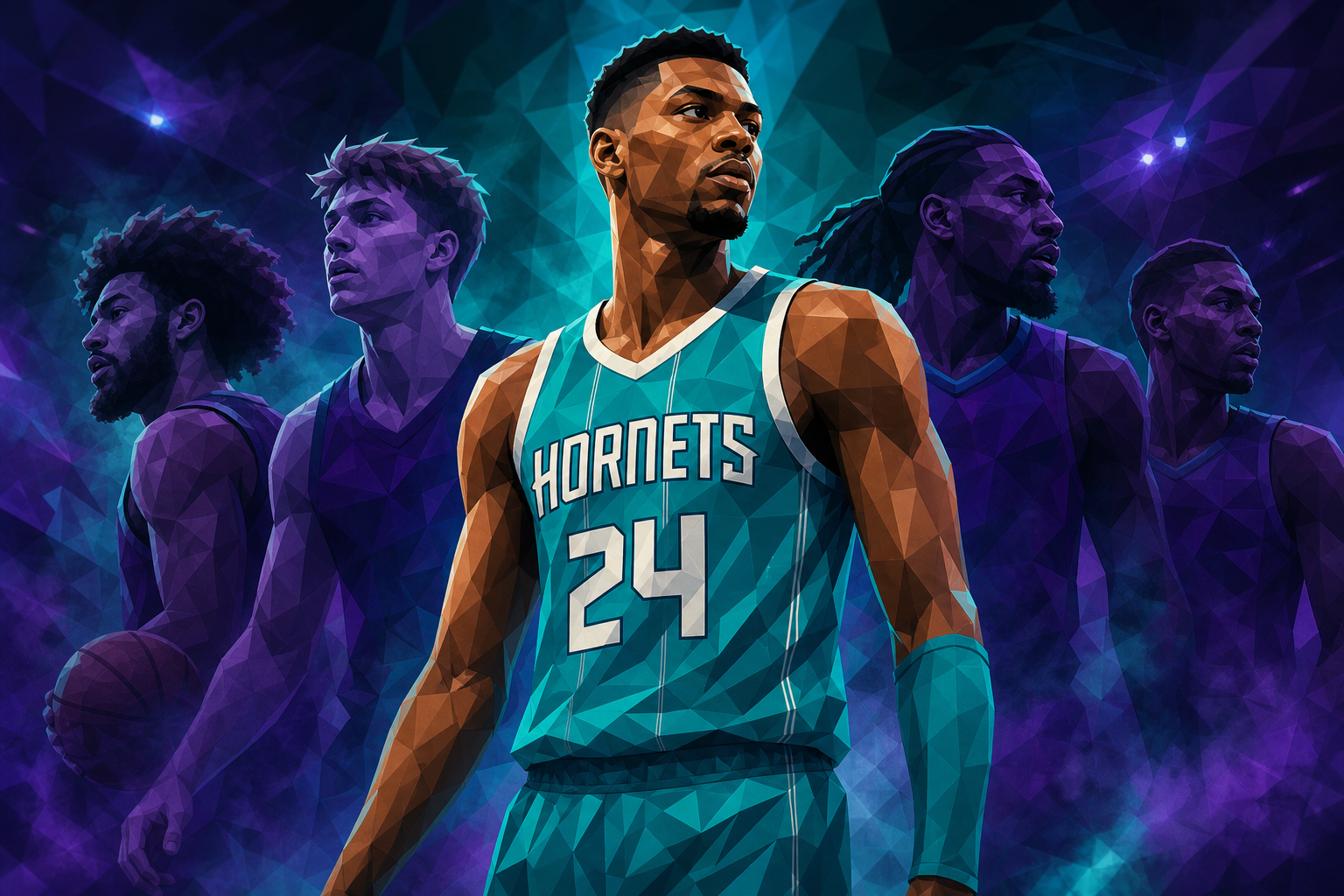
Coby White at PG. Kon Knueppel at SG. Naz Reid at PF. Moussa Diabate at center. The post-trade rotation is deeper than any Charlotte team in a decade — and built from a different philosophy entirely.
Let's start with the headline: the speculation is over. The roster is set, the contracts are signed, and the depth chart — per ESPN's official listings, cross-referenced with NBA.com and multiple beat reporters — is locked. If you've been arguing about who starts in the group chat, you can stop now. Here's who it is.
Signed to a 3-year, $74M fully guaranteed deal on July 6. The North Carolina native isn't a bridge or a placeholder — he's the starter.
The question with White has never been talent. He averaged 15.6 points in 21 games after his midseason trade from Chicago and has the kind of two-way game Charles Lee wants to build around. The question is which Coby White shows up. In Chicago, White was a primary initiator (2023-24, 19.1 PPG) one year and an off-ball gunner the next. The Hornets' system is built on pace, ball movement, and floor spacing — and White's 6'5" frame, improving catch-and-shoot game (38% from three post-All-Star), and ability to play both on and off the ball suggest he could be a legit fit. But he has never been the lead guard for a team competing for a play-in spot. The $74M contract says the front office trusts him. Trust isn't proof. We'll get proof in October.
The 2025 lottery pick (4th overall) is the starting shooting guard. Not a development project, not a future piece — a starter. Kon led the entire NBA in three-pointers as a rookie (273 makes). Ahead of Curry. Ahead of Edwards. Ahead of everyone. The scouting criticism was always quickness — "is he athletic enough to create separation?" He answered it with 273 made threes and a 2nd-place Rookie of the Year finish. The debate about whether he can start ended somewhere around the 150th make.
Charlotte's best perimeter creator. Averaged 20.2 points, 4.9 rebounds, and 3.3 assists in 65 games in 2025-26 — a full-season breakout after wrist surgery limited him to 27 games the year before. He is the closest thing this roster has to a go-to scorer. But there is an asterisk next to his name that we cannot ignore: Miller underwent left shoulder surgery on May 6, 2026. ESPN lists him as day-to-day for training camp. The Hornets are saying all the right things, but shoulder surgery on a 23-year-old wing who creates offense off the dribble is not a minor footnote. If Miller is limited, this rotation looks very different — and not in a good way.
Acquired from Minnesota in the LaMelo Ball trade, Reid is the starting power forward — not center. The distinction matters because it changes the entire identity of the offense. At PF, Reid spaces the floor (39.5% from three in 2025-26) while Moussa Diabate anchors the middle. That means Charlotte has four of five starters shooting 38%+ from deep — and a center who doesn't need the ball to be effective. Reid is a matchup nightmare for traditional fours who can't guard the perimeter, and a switchable defender who held his own in Minnesota's drop scheme. The 2024 Sixth Man of the Year is now a starter. That's a bet on versatility over specialization — and it's the right bet.
The big who earned rotation minutes last season is the projected starting center. Not because the front office sees him as a star — because he fits what Charles Lee's defense needs. Diabate is mobile enough to switch onto guards, long enough to contest at the rim (1.1 blocks per 36), and energetic enough to clean the glass on both ends. He is not a spacer — his offensive role is dive, finish, and offensive-rebound. That works because the four other starters can space. Simple math.
Behind him, the center depth is a competition between two rookies with very different profiles. Hannes Steinbach, the 14th overall pick out of Washington, is the long-term answer — a true 7'0" with defensive feel, pick-and-roll instincts, and a developing catch-and-finish game above the rim. He projects as a starter in 12-18 months, but opening night belongs to the guy who's already been through training camp with this core. Steinbach will get 18-22 minutes as the first big off the bench, and he may also see time at PF in certain matchups — his mobility against slower fours is an interesting wrinkle Lee can exploit.
Ryan Kalkbrenner, the 7'1" Creighton product, rounds out the center depth as the third-string option — a drop-coverage specialist who protects the rim but gets cooked on the perimeter. Insurance policy, not rotation lock.
The front office's bet on Steinbach doesn't require him to start from day one. Diabate starts; Steinbach learns; and by December the split could look very different.
Charlotte ran 8-deep last season with a bench that ranked 27th in defensive rebound rate. That's not a playoff rotation — that's a survival rotation. The 2026-27 roster is 12-deep with wings who shoot and bigs who switch. Here's how it maps out:
Guard rotation: Christian Anderson Jr. (18th overall, 2026) is the backup PG — a lead-guard creator who can run the second unit. Tre Mann returns as a combo guard. Grayson Allen, acquired from Phoenix, is the primary backup at SG — a 39% three-point shooter who defends two positions and has started on playoff teams. That's three guards behind the starters who could start on half the teams in the league.
Wing rotation: Royce O'Neale, also from Phoenix, slots as the backup SF/PF — a 6'5" wing who has shot above 38% from three in four of the last five seasons and has guarded everyone from Jayson Tatum to Jimmy Butler in playoff series. Sion James, acquired from Brooklyn, adds another 6'5" defensive presence on the perimeter. The Hornets haven't had this kind of wing depth since the early Kemba years.
Big rotation: Behind Diabate, rookies Steinbach and Kalkbrenner split the backup center minutes — Steinbach as the mobile, switchable option; Kalkbrenner as the drop-coverage rim protector against traditional back-to-the-basket centers. Grant Williams returns as the third-string PF — a defensive-minded forward who can knock down corner threes. Tidjane Salaün, the 2024 lottery pick, enters year three as a developmental wing/big tweener who could see spot minutes at both forward spots.
The depth is positional, not just numerical. Every backup is a viable NBA rotation player — no one is a training-camp invite eating garbage minutes. Charlotte's bench ranked 19th in scoring last season (36.2 PPG). Expect that number to climb simply because the roster profile changed: more shooting, more defensive versatility, fewer specialists who can only play one role.
The rotation looks clean on paper. But the Hornets enter the season with points of fragility that no depth chart can solve by itself.
Brandon Miller's shoulder. Surgery in May 2026. Listed game-time decision per ESPN. If Miller misses games — or starts the season on a minutes restriction — the entire rotation shifts. Grayson Allen becomes the starting SF. Royce O'Neale moves up. Sion James gets real minutes. The depth that looks like a strength becomes a necessity. That's the difference between a 42-win team and a 35-win team.
Hannes Steinbach's rookie adjustment. Steinbach isn't starting — Diabate is — but his 18-22 minutes off the bench will be the most-scrutinized rookie minutes on the roster. Can a 7'0" German who played at Washington hold his own against NBA second units? The early answer will shape whether Charlotte looks for a veteran center at the trade deadline. His ability to slide to PF in certain lineups adds positional versatility the Hornets haven't had from a big since PJ Washington left.
Coby White's fit adjustment. White has started before, but he has never been the primary initiator for a team that expects to compete. The $74M deal makes him the highest-paid player on the roster. The pressure of that role — and whether he can sustain 30+ minutes over 82 games — is one of the two or three biggest questions of the Hornets' season.
Look 1 — The Spacing Five: White, Knueppel, Miller, Reid, Diabate. Four players who shoot 38%+ from three around a mobile big who doesn't need touches. The primary lineup, expected to play 18-22 minutes per game together. This is the identity lineup — if it works, the Hornets have something real.
Look 2 — The Switch-Everything Lineup: White, Allen, O'Neale, Reid, Diabate. Four players who can guard at least two positions, with Allen and O'Neale as the wing stoppers Charlotte didn't have last season. Used against teams with multiple creators — Cleveland, Boston, Orlando. This is the lineup that answers the question "can the Hornets actually defend anyone?"
Look 3 — The Youth Movement: Anderson, Knueppel, Miller, Salaün, Steinbach. All five are Hornets draft picks — a lineup built entirely from the last four drafts. Not a closing lineup, but a useful 6-8 minute developmental look that lets Steinbach operate as the roll-and-finish anchor while Anderson and Knueppel run the two-man game. If this lineup is +3 or better over a 15-game stretch, the future arrived early.
The Charlotte Hornets will take the floor in October with a starting lineup that includes zero All-Stars, a point guard who was a midseason throw-in 18 months ago, and a center who was a third-stringer two seasons ago. On paper it doesn't scare anyone. And that's exactly the point.
This is not the Hornets' ceiling. This is the floor. The ceiling depends on whether Kon Knueppel is a 273-three rookie or a career shooter, whether Brandon Miller's shoulder holds up, and whether a frontcourt of Naz Reid and Moussa Diabate can survive a seven-game series against Giannis and Bam. But the floor — 12-deep, switchable, and built to shoot — is the highest it's been in Charlotte since the Bobcats became the Hornets. That's not a ceiling. That's a starting point.
Related Swarm Outpost coverage: Why the Hornets Traded LaMelo for Naz Reid · Why the Hornets Took Christian Anderson Jr. at #18 · Hannes Steinbach: the size pick Charlotte needed · Eastern Conference Blueprint.
SI says 42-40. Heavy says the defense isn't good enough. The group chat has been arguing for a week. Where do you land?