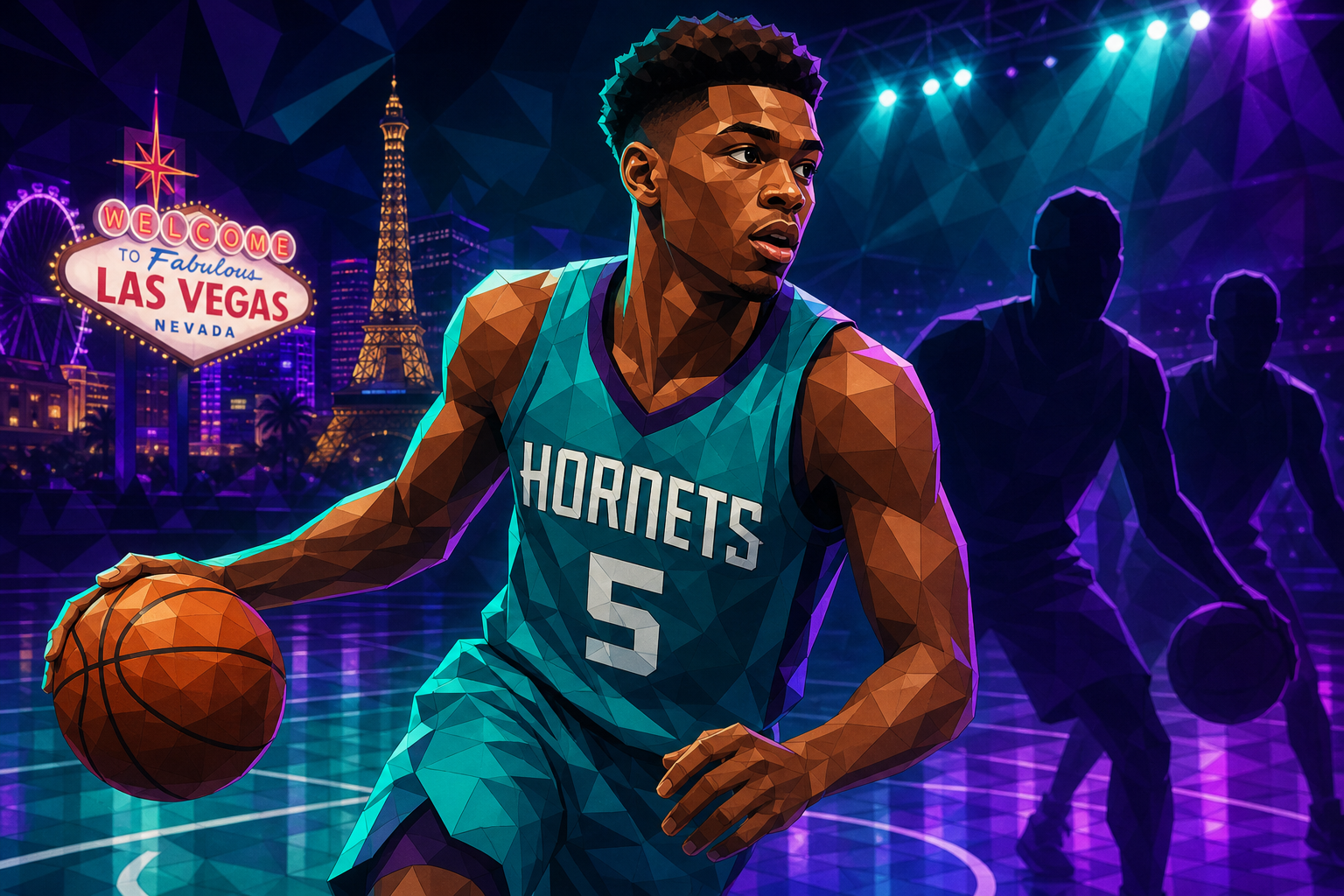
Up close with Anderson, Philon, Thomas, Boswell, and Pullin — the full Summer League PG report
Anderson's Summer League has been the opposite of an instant breakout — and that's not necessarily a bad thing. The debut was ugly on paper, but there was more to it than the box score showed.
Anderson opened Summer League on July 10 against the Magic with a stat line that made draft sceptics feel vindicated: 6 points, 1 rebound, 2 assists, 2-of-11 from the field, 0-of-5 from three. The Hornets won 86-74, but Anderson wasn't the reason.
Watching the game told a different story. One observer noted he was "EXTREMELY impressed" with Anderson's pace, his sharp passes under pressure, and his ball decisions against on-ball defence. The shot simply wasn't falling. But the process — the reads, the pace, the willingness to run the offence — was there. For a rookie point guard in his first professional game, that distinction matters.
Christian Anderson Jr. (CHA) debut:
6 PTS
1 REB
2 AST
2-11 FG
0-5 3PT
Hornets win 86-74
Anderson bounced back against the Pelicans with 12 points, showing better rhythm and shot selection. He wasn't forcing the issue, letting the game come to him. The improvement was subtle but real — the kind of adjustment coaches want to see between games.
Game three against the Celtics was Anderson's best performance yet — 13 points on 50% shooting, 3-of-8 from deep (37.5%), 4 rebounds, and 2 steals. The difference was visible. He attacked closeouts with purpose. He spaced the floor off the catch and fired threes with confidence. He competed defensively, picking up deflections and staying in front of his man.
Christian Anderson Jr. — 13 PTS, 4 REB, 2 STL, 3-8 3PT vs. Celtics. His strongest Summer League showing yet — and a sign that the slow-build approach is working for the Hornets' rookie point guard.
Hornets coaches have emphasised that Anderson is the only true point guard on the Summer League roster (per multiple beat sources). He's getting all the on-ball reps he can handle, and the improvement from game 1 to game 3 — from 18% shooting to 50%, from timid to assertive — is exactly what a front office wants to see from a developmental pick. Anderson is averaging 10.3 points across three games. Not eye-popping. But the arrow is pointing up.
Four picks. That's all that separated Christian Anderson from Labaron Philon Jr. in the 2026 NBA Draft — and right now, Philon is making 21 other teams wonder what they missed.
The Philadelphia 76ers grabbed Philon at pick 22 out of Alabama, and the 6'5" point guard has been one of the most complete floor generals in Las Vegas. His college resume was impeccable — 22 points, 5 assists, 39.9% from three, 62.6% true shooting as a sophomore — and he's translating it to the Summer League floor.
Philon's debut was a statement. He ran the Sixers' offence with the kind of veteran poise that makes scouts reach for the "NBA-ready" label. He wasn't forcing shots, reading the defence on pick-and-rolls, and finding cutters. 4-of-10 from three showed legitimate range.
Then came the Indiana game — and this one was special. Philon logged 34 minutes, scored a game-high 24 points on 9-of-22 shooting, added 6 assists and a steal, and finished with a +14 plus/minus in a 100-93 overtime victory. He was clutch down the stretch, creating his own shot in isolation and drawing fouls when the Pacers turned up the pressure.
Labaron Philon Jr. (PHI) vs. IND (Summer League OT win):
24 PTS
3 REB
6 AST
1 STL
2 TO
+14
34 min
6'5" Alabama PG looked NBA-ready in the clutch.
If Philon is the "one that got away at 22," Meleek Thomas is the "how did he fall to 34?" story — and it's the one getting the most attention.
Thomas went 34th overall to the Cleveland Cavaliers — a 6'5" Arkansas combo guard who averaged 15.6 points, shot 41.6% from three on 197 college attempts, and earned SEC All-Rookie honours. Pre-draft mocks had him anywhere from 25th to 42nd. Cleveland saw value. They were right.
Thomas opened Summer League with a smooth 20-point outing that hinted at what was to come. He shot 7-of-15 from the field, hit 2-of-5 from three, and mixed in a steal. Efficient, controlled, bordering on effortless. The kind of game that makes you check the draft board again to confirm he really went at 34.
Then came the explosion. In 33 minutes against the Pistons, Thomas dropped 30 points (10-24 FG, 4-10 3PT), dished 7 assists, grabbed 4 rebounds, and picked 4 steals. He was everywhere — scoring from three levels, creating for teammates in transition, disrupting passing lanes on defence. Observers called it "spectacular." The "steal of the draft" label suddenly had a 30-point Summer League game to back it up.
Meleek Thomas (CLE) vs. DET — Summer League:
30 PTS
4 REB
7 AST
4 STL
2 TO
10-24 FG
4-10 3PT
33 min
Steal of the draft? The 6'5" Arkansas guard is making a case.
The difference between Philon and Thomas is archetype. Philon is a point guard who scores; Thomas is a scorer who passes. At 6'5" with a positive wingspan, Thomas is being asked to create his own shot and pressure the rim — and he's delivering. The Hornets' case against drafting Thomas at 18 is clear: he's not a pure point guard. He's a combo guard who needs the ball to be effective, and Charlotte already has Coby White as its primary creator. But that logic gets harder to defend every time Thomas drops 30-7-4 in a Summer League game.
Three guards drafted lower than Anderson — Philon at 22, Thomas at 34 — are outperforming him in Summer League. The gut reaction is to call it a miss. The fuller picture is more complicated.
Both Philon and Thomas are 6'5" guards who can create their own offence. Anderson is a 6'1" true point guard whose game is built around pace, decision-making, and limiting mistakes. Different archetypes, different development curves. Philon and Thomas were always going to pop more in a free-flowing, low-defence Summer League environment. Anderson's game translates more to the regular season, where structure and execution matter more than athletic creation.
The value argument cuts both ways. Thomas was projected late first / early second. Taking him at 18 would have been a reach — not by much, but enough that a GM would have to defend the board. Anderson at 18 was exactly where the mock consensus put him. Philon at 22 was value. The Hornets didn't reach; they took their guy at his range.
Picks 18, 22, and 34 aren't the only places to find a backup point guard. Summer League is also where undrafted free agents write their own ticket.
The most relevant name for Charlotte fans might be one that's already in the building. Kylan Boswell — an undrafted 6'1", 226-pound floor general from Illinois — signed a two-way contract with the Hornets ahead of Summer League. His debut was quiet (0 points, 2 assists). His second game? A revelation.
Against the Pelicans on July 11, Boswell played 15 minutes and put up 8 points on a perfect 3-of-3 from the field (2-of-2 from three), plus 7 assists and 0 turnovers. Seven assists, zero turnovers in 15 minutes. That's a 48-minute pace of 22.4 assists. It's a small sample, but it's the kind of efficiency that backup point guard minutes are built on.
Kylan Boswell (Hornets two-way) vs. NOP — Summer League:
8 PTS
3-3 FG
2-2 3PT
7 AST
0 TO
15 min
Hornets HC Blaine Mueller: "He played with more confidence. He got us into our sets."
Boswell averaged 12.9 points, 4.0 rebounds, and 3.1 assists at Illinois — numbers that projected him as a late-first / early-second prospect before he went undrafted. At 226 pounds, he's built like a brick wall for a point guard, and his willingness to run the offence and protect the ball is exactly what Charles Lee wants in a backup. The Hornets have a low-cost, high-upside PG developmental option in the pipeline — and they didn't have to spend a draft pick to get him.
Then there's Zyon Pullin. The undrafted point guard out of Florida — now on a two-way with the Minnesota Timberwolves — has been the most productive floor general in Las Vegas that nobody's talking about nationally.
Pullin's Summer League debut was absurd: 24 points, 12 assists, and 8 rebounds in a 105-92 win over the Pelicans. Through two games, he's averaging 24 points, 6.5 rebounds, 7.5 assists, shooting 46.4% from the field and 40% from three.
Zyon Pullin (Timberwolves two-way) SL debut vs. NOP:
24 PTS
12 AST
8 REB
1 STL
2 BLK
W 105-92
Undrafted PG out of Florida is balling in Vegas.
Pullin's path tells you everything about how the NBA finds backup point guards. Undrafted in 2024. Miami Heat Summer League. A two-way with Memphis. Waived. A two-way with Minnesota. G League numbers that screamed "rotation player" — 27.8 points, 6.7 assists, 49% from three with the Iowa Wolves. And now he's in Vegas putting up 24-and-12 like it's nothing. The Hornets could have signed Pullin at any point in the last two years. So could 28 other teams. And every one of them is watching his Summer League tape right now.
The Hornets' need for a point guard was real. They addressed it three ways: Coby White as the veteran starter on a descending 3-year, $74M deal; Christian Anderson at #18 as the developmental lottery ticket; Kylan Boswell on a two-way as the safety net. The plan is coherent — win now with a veteran scoring guard, build for the future with a rookie playmaker, develop a two-way prospect as insurance.
Labaron Philon and Meleek Thomas are reminders that the draft is an imperfect science. A 6'5" guard who shoots 41% from three and drops 30-7-4 in Summer League would have been a first-round pick in a re-draft. A point guard averaging 21 and 6.5 at pick 22 is exceptional value. Cleveland and Philly both got their guys at the right spots.
The real test for Anderson starts when the regular season tips off and Charles Lee has to decide how many backup-PG minutes to entrust to a 20-year-old rookie. If Anderson is shooting 36% from three and posting a 2:1 assist-to-turnover ratio by December, the Summer League noise will have been exactly that — noise. If he's still shooting 18% and looking tentative, the Philon and Thomas questions won't go away.
Summer League is not a verdict. It's a first draft. And the Hornets' PG room still has four months of revisions ahead of it.
— CW Lee
All stats sourced from X/Twitter posts by league observers (DailyNBAStats, MrBuckBuckNBA, sahil_mittal24, REichten, ArmchairIllini). College stats per public draft profiles. Summer League data from Las Vegas NBA Summer League, July 2026. Player comparisons based on draft position, scouting reports, and verified game performances.